
Interlude 02 — Chapter 01
Paddock Girl
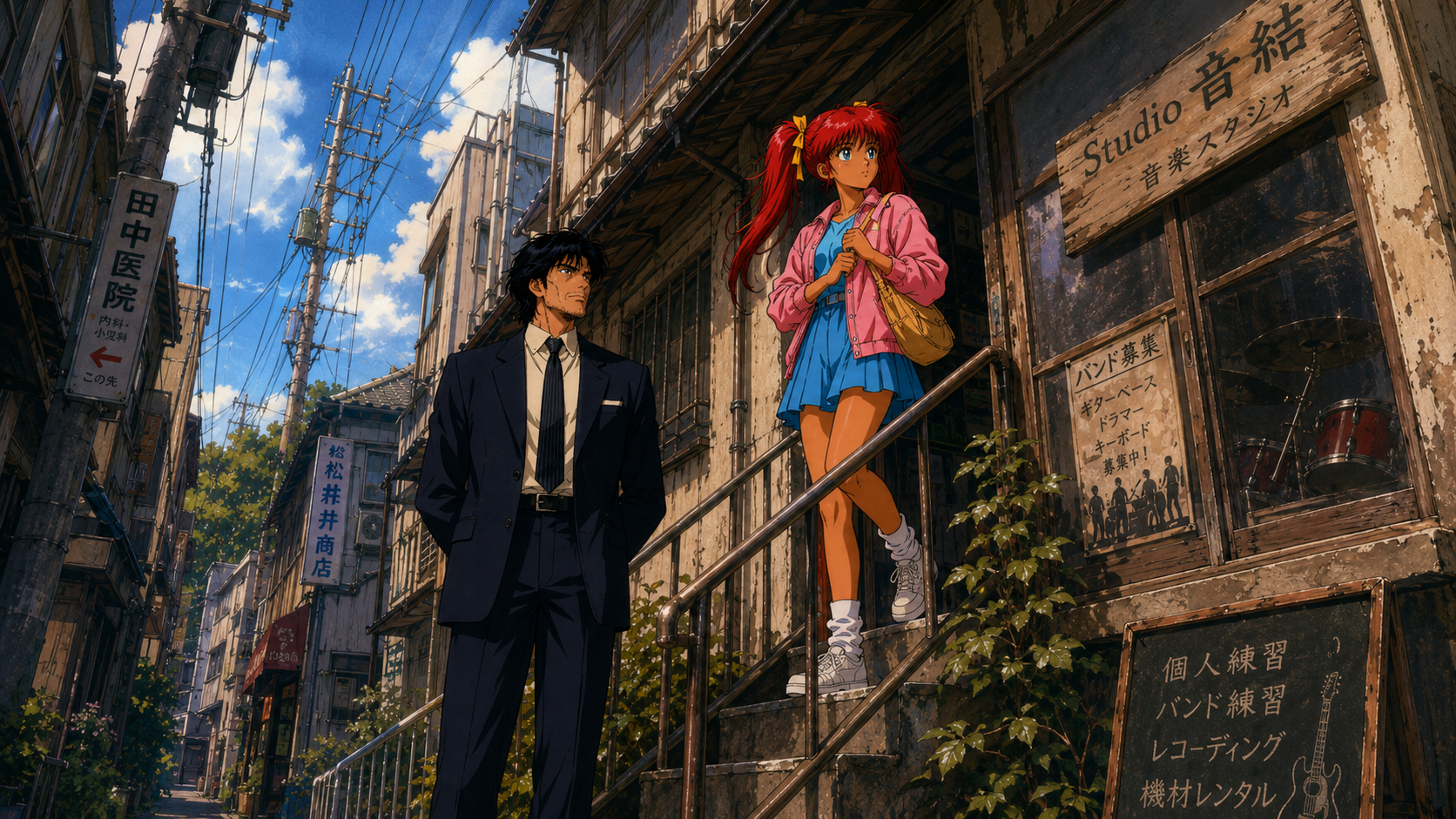
The studio sat on a narrow Kyoto side street like it was trying not to be found.
Shun had booked it for me to register a new single, which sounded glamorous until we actually reached it and discovered that studio was, once again, being used in the most charitable sense possible. The live house was practically next door, its walls already bleeding faint drums and bad ambition through the concrete, while this place looked like another cramped storage room that had learned a few technical words and started lying about its profession. Small sign. Chipped frame. One dusty window. No grandeur anywhere.
Here’s a tightened rewrite with that added beat folded in naturally:
Sasaki and I climbed the short flight of stairs in silence until, naturally, he decided silence had gone on long enough.
“Using that name,” he said, calm as a tax notice, “remains a dangerous decision.”
I glanced sideways at him while adjusting the strap on my bag. “You say that like it’s new information.”
“Repetition,” he replied, “sometimes helps.”
I smiled. “Not with me, it doesn’t.”
He kept his pace exact, hands folded behind his back, suit immaculate in a city determined to wrinkle everything.
“Someone may notice.”
That got a laugh out of me. A real one.
“Sasaki, anyone who might notice is either dead or living in another galaxy.”
He did not laugh back. He just gave me that infuriatingly level look of his—the one that always suggested he had already run ahead of the conversation and disliked what he found there.
“A deeper analysis indicates a high chance that someone still remains,” he said. “I do not know who he is, but he has been pulling strings here for some time.”
I rolled my eyes, though not quite hard enough to hide the flicker in my chest.
“That might be,” I said, “but even so, I am just a girl now. Just a girl trying to break it big in Japan.”
Sasaki’s expression barely shifted.
“This new world may be worse than the one you left,” he said. “Smaller. Meaner. Less honest about its appetites. You could still go back. Recalculate. Build another plan.”
I stopped halfway up the last step and looked at him.
“No,” I said.
He waited.
I adjusted my bag again, more to settle myself than anything else. “I’ve made up my mind. The past is gone. Whatever was there, whatever I was there, it’s over.” I pushed open the outer door and gave him a small, sharp smile. “This is my life now.”
Sasaki followed without haste.
“Yes,” he said dryly. “And history is full of harmless girls with no consequences attached to them.”
I grinned and stepped inside.
“Exactly. So let’s not ruin the illusion.”
Inside, the whole building smelled faintly of dust, old wiring, and instant coffee. A thin corridor led to what was apparently the reception area, though that turned out to be a very optimistic label for an old man on a chair outside what should have been the recording room. He sat there like he’d been installed with the building—small, gray, slightly folded into himself, newspaper on one knee, glasses low on his nose, expression caught somewhere between boredom and suspicion.
I slowed.
Sasaki did not.
He just came to a stop beside me with the same precise stillness he brought everywhere, while I looked from the old man to the door behind him.
“I’ve got a booking,” I said.
At exactly the same moment, another voice—a girl’s voice, low and sharp—said the very same thing from behind me.
I turned, already annoyed, and found trouble in leather.
She stood half a step back in the corridor light, dressed in red and black like someone had engineered a paddock girl out of danger and good legs. The miniskirt was about as high as physics and shamelessness could negotiate, the boots added two extra inches of command, and everything above them suggested she knew exactly what effect she had and had long since stopped apologizing for it. Her hair was black—no, blacker than that, the kind of dark that swallowed light instead of reflecting it. Same with the eyes. Deep, hard, unreadable. She looked at me the way I was already looking at her: quick, measuring, unimpressed.
“Shun Tachibana booked for me,” I said.
“Same here,” she replied.
That was when I noticed it. Not the clothes. Not the face. The attitude. Matching edge. Same clipped certainty. Same refusal to give an inch for free. She had grit all over her, the kind you could hear before she opened her mouth. If I’d met her anywhere else, I might have smiled. Here, in front of my miserable little studio appointment, I mostly wanted to win.
Behind us, the old man rose at last with the solemn effort of someone personally offended by sudden movement. Sometime during our bickering he had taken a ledger down from the wall, and now he approached holding it open in both hands like a priest carrying disputed scripture. Slowly, carefully, he came toward us, peering over his glasses first at me, then at her, while the corridor narrowed around the three of us and the argument prepared to become official.
Sasaki spoke before I could.
“You must be Saki Sawajima.”
The girl looked at him with perfect indifference, as if being identified was not the same thing as being impressed. Then she flicked her eyes back to me.
“Shun booked it for me,” she said.
The old man finally joined the living. He lifted the ledger between us, squinting at the page as though hoping the ink might apologize.
“He booked for you both,” he said.
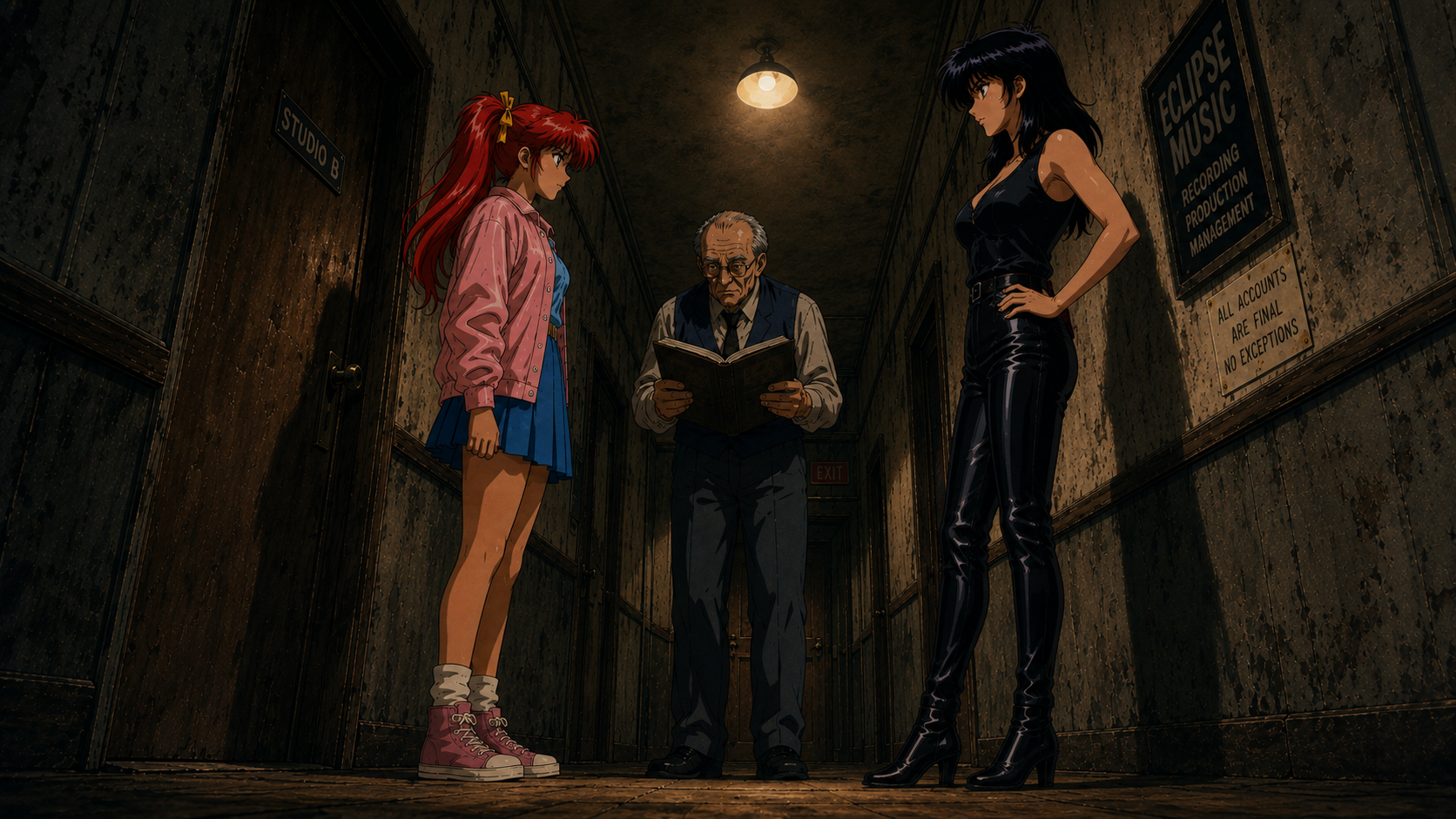
That landed with all the grace of a chair leg giving out.
I stared at the ledger. Of course. Of course Shun hadn’t had enough cash for a single proper booking and had solved the problem by turning two singers into a scheduling accident.
We looked at each other, Saki and I, and reached the same conclusion at the same time: neither of us liked this, neither of us had a better option, and if we wanted studio time at all, we were going to have to share it.
So we agreed the way people agree to rain—reluctantly, with attitude.
Saki gave the smallest shrug, then moved first. Naturally. She slipped past the old man and pushed open the studio door.
“Hey,” I called after her, already irritated again. “Who decided you go first? I was here before.”
She glanced back over one shoulder, black eyes flat and amused.
“And I just overtook you,” she said, and disappeared inside.
I followed her into a room so small it felt less built than assembled from leftover corners.
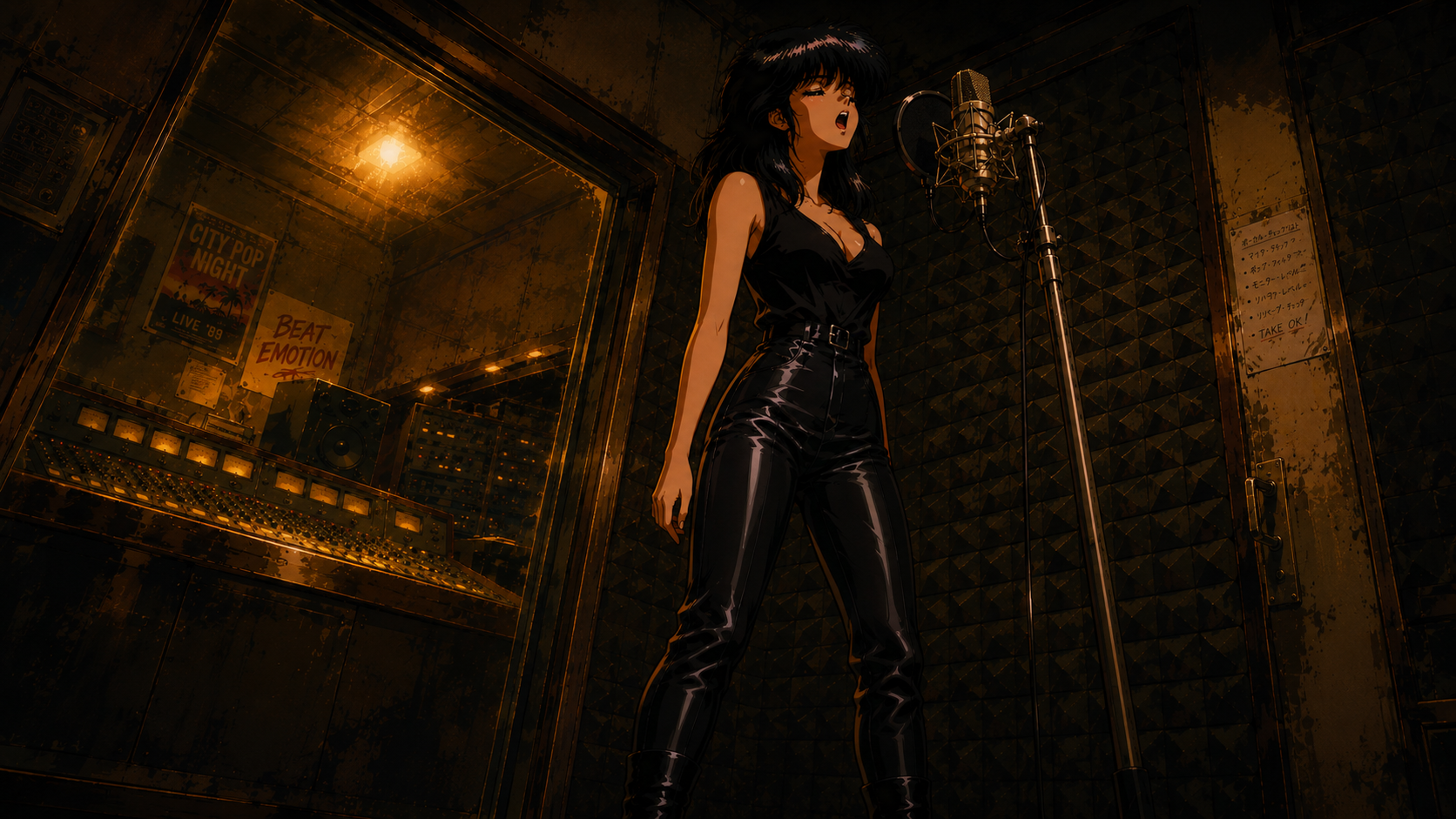
The recording space was cramped, low-ceilinged, and fully committed to the fiction that size did not matter. The control room was barely separated from the booth by a glass pane clouded at the edges with age and nicotine ghosts. Everything looked dated, lived-in, touched too many times by too many hands trying to make things work one more session longer.
The mixing desk was old enough to have opinions. Buttons were yellowed. Sliders had that softened look of overuse. Cables nested in the corners like black vines. Ashtrays, coffee rings, handwritten labels, a pair of half-dead headphones hanging off a metal hook—it all carried the exhausted dignity of a place that had recorded just enough truth to survive looking like this.
The booth itself was hardly a booth at all, more a padded square cut out of necessity than design. Foam tiles clung to the walls in uneven patches. The mic stood in the center with a pop filter that had clearly seen things. A narrow stool leaned against one side, unused and vaguely judgmental.
There was just enough room for a singer, a breath, and whatever dream had managed to squeeze in with her.
Saki stood inside it already, like she belonged there by force of will alone.
And I, looking at that tiny boxed-in space and the old machinery surrounding it, had to admit the room had one virtue: if you weren’t good enough, there was nowhere to hide.
Saki went in without another word and set her bag down by the wall like she’d already decided the place belonged to her for the next fifteen minutes.
The old man shuffled past us and lowered himself behind the console with the solemnity of a man sitting at the controls of a ship he might or might not have sunk before. So that was the arrangement. Receptionist, bookkeeper, sound engineer, probable owner, and possibly undertaker. Efficient, in a deeply alarming way.
Saki stepped into the booth again, pushed one side of her hair back, adjusted the headphones, and gave a short nod through the glass.
A mellow track floated into the room—soft electric piano, restrained drums, that warm city-pop ache that always sounded like summer remembering itself badly.
Then she began.
At first, the whole thing threatened to die on the spot. Her first line came in crooked through the speakers, too thin, then suddenly too loud, the reverb wrong, the balance a mess. The old man flinched at his own knobs a second too late and corrected nothing with great confidence.
Saki stopped, pulled one earcup off, and gave him a look that could have punctured sheet metal.
He muttered something, twisted a dial, tried again.
The second pass was better, technically. Not good. Better. Enough for the melody to settle into itself.
Endless skies, sunlight in your eyes. Aoi yume—blue dream—fading with the breeze.
Classic city pop, I thought. Clean. Sad. Stylish. The kind of song made for late trains, unanswered calls, and expensive regret.
Then I really listened.
Saki wasn’t singing a song. She was singing damage.
By the second verse—Golden days, laughter in the haze. Toki wa kie—time disappears—but the feeling stays—I could hear it under the melody, hot and buried and refusing to die.
The bridge opened and something in her voice changed, not louder, not bigger, just more naked:
In dreams, we meet again. Yume de aeru kara. Because in dreams, we can still meet. Our souls, shining bright. Kokoro mada hikaru. The heart still shines.
No. Not a love ballad. Not really. This was grief with perfect pitch. A wound dressed up in city-pop satin.
She stood in that tiny booth with her chin up and her black eyes half-lidded, and every line came out like she was trying to hold herself together by singing straight through the fracture.
By the chorus—Hold on to what remains. Kimi o wasurenai. I won’t forget you. Love burns through all the pain, still here inside the flame—I stopped seeing the leather, the attitude, the challenge in the corridor.
I saw the truth instead.
Saki Sawajima wasn’t performing heartbreak. She was surviving it in real time.
A break came, if that was the word for the wounded silence after a bad take.
The recording had gone wrong in all the ordinary ways—levels off, warmth lost, timing dulled by bad handling—but what stayed in the room wasn’t technical failure. It was the feeling Saki had dragged out of herself and then been forced to drop on the floor while the equipment failed to catch it.
My turn had come.
I stepped toward the booth and found her just outside it, standing still for one dangerous second too long. Her face had gone distant. Not empty—worse. Exposed. Then I watched it happen: the snap back into posture, into coolness, into the hard little shield she wore like leather.
Only now I could see through it.
“Hey,” I said.
She looked at me, guarded already.
“Give it another shot. Sasaki will set you up. He’s…” I glanced once toward the console, where Sasaki was already studying the board with quiet contempt. “Quite capable.”
Saki’s mouth tightened.
“No. Take your turn.”
I was already closer by then. Close enough to put one hand lightly on her shoulder and make her actually meet my eyes.
Up close, the stubbornness was still there, but it had started to melt around the edges.
“You’ve got the right feeling now,” I said. “Don’t let it pass. Sing it.”
For a second she just looked at me. Really looked.
Then the corner of her mouth twitched into the smallest smirk, the kind that admitted nothing and accepted everything.
She gave one short nod.
I stepped back.
Sasaki was already behind the console, sleeves untouched, posture immaculate, fingers settling over the old controls as if the machine had been waiting years for somebody competent to arrive. The old man surrendered his chair without protest and with visible relief.
Then the track began again.
This time the room held.
Sasaki adjusted levels with quiet precision, cutting through the mud, finding the shape of the voice, building space around it instead of smothering it.
Saki stepped into the first line and the song came alive at once—cleaner, deeper, sharper in all the places that mattered. The ache remained, but now it landed where it should. The piano breathed. The reverb warmed instead of drowning. Her voice sat right in the center of it, grief and control in perfect balance.
By the bridge, the whole little studio had gone still around her.
By the final chorus, there was nothing left to fix.
The take ended, and for a beat even the tired old room seemed to know it had just witnessed something real.
The recording was perfect.
By the time my own take was done and the half day finally coughed itself to an end, I felt wrung out, starved, and weirdly triumphant. The studio had managed, against all visible evidence, to produce actual recordings. A minor miracle. Sasaki and I came back up from that underground broom closet impersonating a music facility and stepped into the Kyoto daylight just in time to find Saki waiting outside with a small white plastic bag hanging from one hand.
She lifted it slightly when she saw us. “Want some?”
I blinked. “Is that food?”
She nodded toward the drink crates stacked beside the wall. “Sit.”
I smiled at once. “Oh, I like you now.”
“Don’t rush it,” she said.
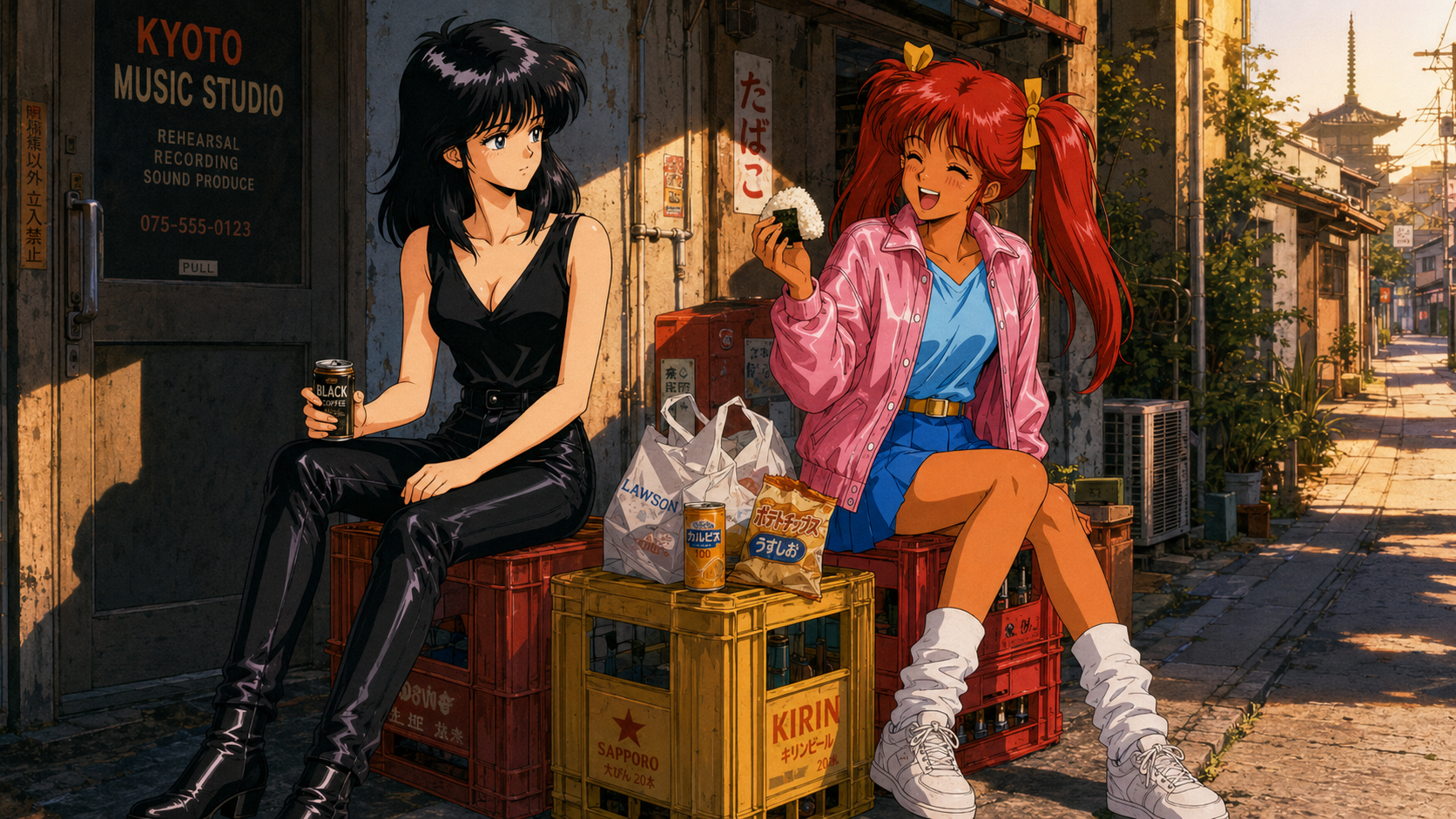
We sat on the crates like underpaid survivors of some very niche war. Saki opened the bag and started handing things out with zero ceremony—rice onigiri, a couple of packaged side dishes from 7-Eleven, canned drinks, one sad little sandwich trying its best to matter. To me it looked like treasure. Pure treasure.
“You got all this?” I asked, already halfway into an onigiri. “For us?”
“You looked like you were going to pass out in the second verse,” she said.
“That is the nicest thing anyone’s said to me all week.”
“It wasn’t nice. It was medical.”
I laughed with my mouth full, then swallowed and pressed a hand to my chest. “No, really. Thank you. Deeply. Sincerely. Spiritually. I was starving.”
“I noticed,” she said dryly. “You’ve got the energy of somebody being kept alive by orange soda and bad decisions.”
“That is slander,” I said, opening a second package. “It was also barley tea.”
Saki handed a drink to Sasaki. He looked at it, then at her.
“I can’t eat,” he said.
She gave a small shrug and started to pull it back, but I cut in at once.
“It’s a condition,” I said quickly. “Temporary. Sort of. Don’t worry, he’s not being rude. He’s just mysteriously inconvenient.”
Saki looked from me to him. “That so.”
Sasaki inclined his head. “That is an unusually generous summary.”
“You’re welcome,” I said brightly, taking another bite. Then to Saki, with perfect seriousness: “He’s actually worse when he hasn’t eaten. Which is impressive, because he never eats.”
That got the faintest shift at the corner of her mouth.
“Sounds exhausting,” she said.
“Oh, it is,” I replied. “But he folds shirts well and occasionally saves my life, so I’ve decided to keep him.”
“I see,” Saki said.
Sasaki looked straight ahead. “I was not aware this arrangement included your approval rights.”
“It absolutely does,” I said. “I’m the talent.”
“You are certainly expensive to supervise.”
“See?” I said, turning to Saki with a grin. “This is affection. He just has a rare accent.”
That finally got something out of her. Not a laugh, exactly. More the suggestion of one. She opened her drink, took a small sip, then looked at me with that composed little smirk she seemed to keep folded in her pocket for emergencies.
“You know,” she said, “I figured you for one of those Kyoto princess types. A girl who spends all her money on hair dye and walks around with a butler.”
I turned to her with my mouth full of rice.
“Huh?”
She looked back at me and smiled properly then—still small, still controlled, but real enough to change her whole face. And in it I understood something at once. She knew. Not everything, not the shape of it, but enough. She knew I had seen something inside her while she sang. And she knew she had seen something in me too. Beneath the ribbon and the smile and the chatter. For one second we just looked at each other with that quiet recognition only women with bruises in the same places ever really understand.
Then Saki stood, dusted off her skirt, and gave my shoulder a light pat. “Until next time,” she said.
“Next time,” I echoed.
She lifted one hand in a loose wave, turned, and walked off into the Kyoto street without another word—boots clean against the pavement, silhouette sharp for a few seconds in the afternoon light before the city swallowed her whole.
I watched the place where she had gone a little longer than necessary.
And then, unhelpfully, Sasaki’s line from the restaurant came back to me with sudden clarity: Family works in motorsports but her father disappeared two years ago.
Gone. Not away. Gone.
I looked again toward the street where Saki’s silhouette had vanished, now nothing but moving shadows and ordinary people, and felt the warm little happiness of lunch give way to something heavier.
Not pity. Recognition.
And sitting there on a crate outside a miserable little Kyoto studio, with convenience-store rice still in my hands and a city I had chosen spreading out around me, I had the strange, unwelcome, almost comforting thought that maybe this world—the small, noisy, hungry, bruised little world I had stepped into on purpose—was not a terrible mistake after all.