Interlude 01 — Chapter 01
Eden
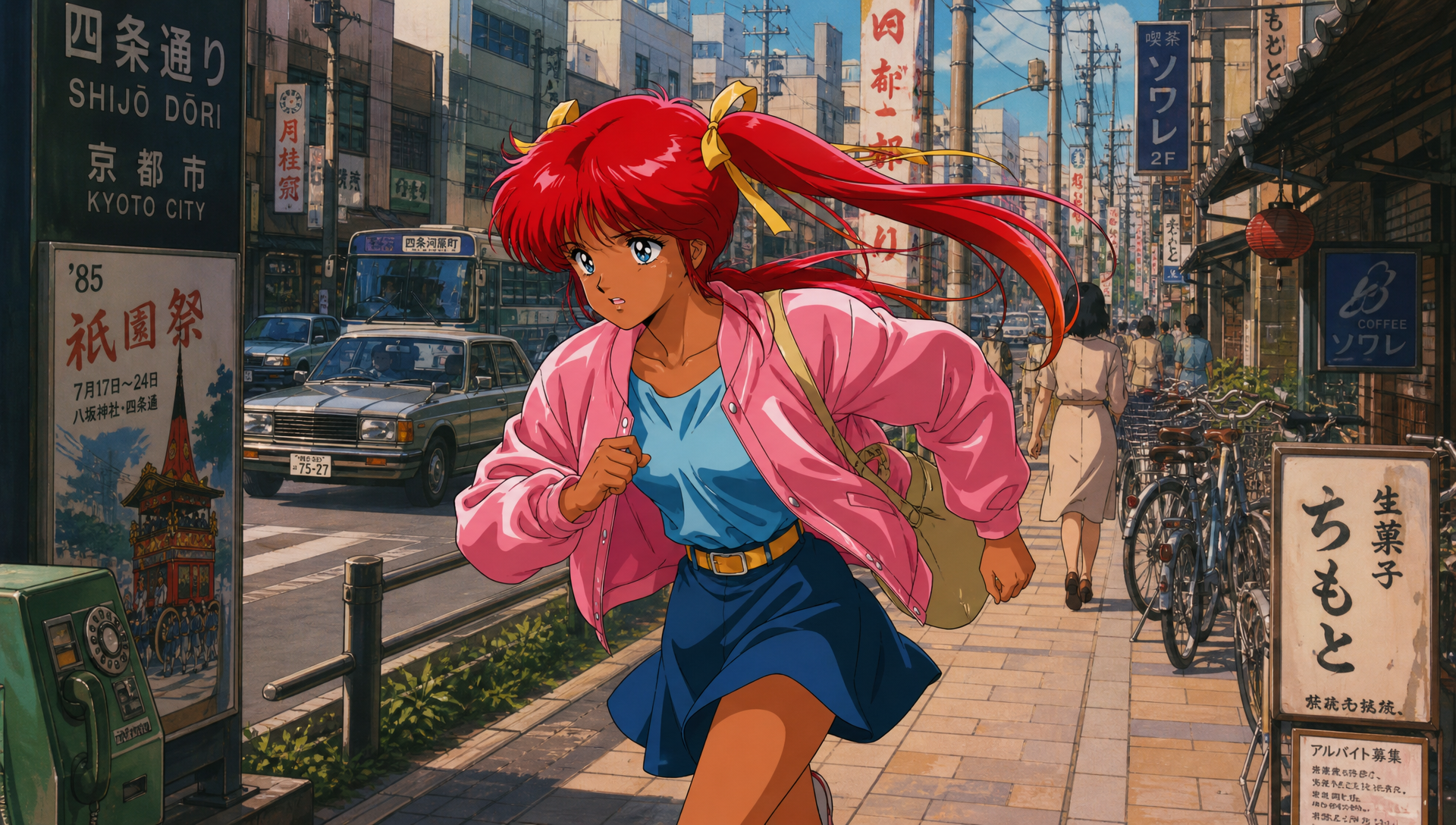
I was late, and Kyoto had chosen that exact moment to become a maze of elbows, briefcases, bicycles, and slow-moving civilians with nowhere urgent to be.
I ran along the narrow sidewalk with one hand clamped over my bag and the other trying to save my red twin ponytails from total collapse, weaving past office clerks and delivery boys under the white glare of a July noon.
I clipped an old man at the corner hard enough to jolt his umbrella loose.
“Mōshiwake arimasen!” I fired back automatically, already half-bowed and half-running.
He wheeled on me, scandalized.
“Watch where you’re going!” he snapped. “I survived the war for this? To be assassinated by a girl with red hair?”
“Sumimasen!” I called over my shoulder, not stopping.
“You young people have no brakes!” he barked after me.
Fair enough, I thought, and kept running.
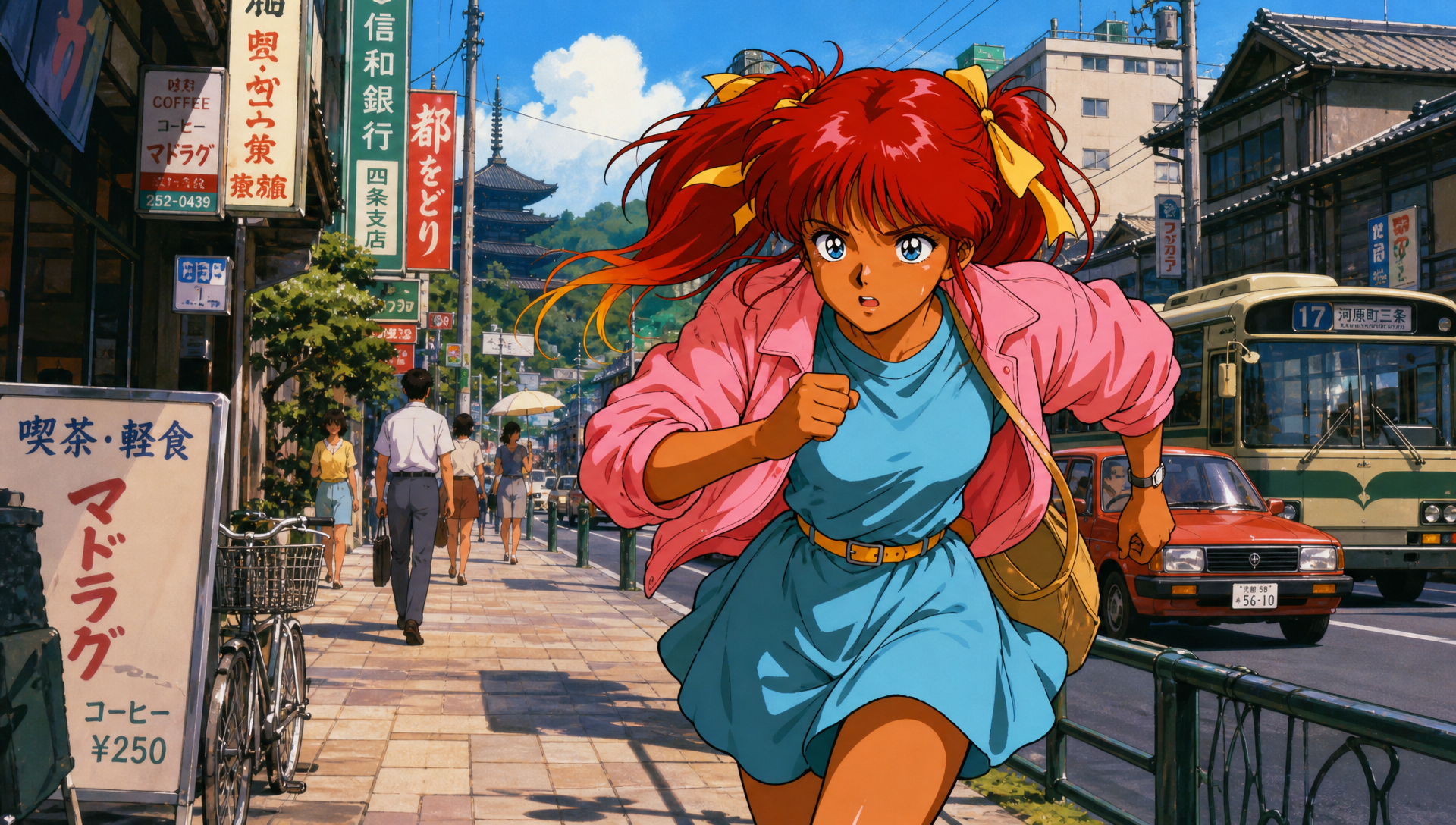
I checked my watch on the run and felt my stomach drop another inch.
I shouldn’t have dyed my hair. That was the thought chasing me down the Tokyo sidewalk as I ran flat out, bag bouncing at my side, red twin ponytails whipping behind me like emergency flags.
Three days ago it had looked bold. Memorable. Idol-adjacent. Today it looked like the reason I was late to a lunch that might decide whether I spent next month singing on a stage or negotiating with my landlord about the philosophical meaning of rent.
I sprinted past convenience stores, vending machines humming in the heat, office workers flowing neatly around me while I zigzagged through them like a pinball.
And there it was, the restaurant. Clean glass front, discreet sign, exactly where it should be.
And standing a few steps away like a patient statue was the man waiting for me: middle-aged, calm, faintly awkward in his suit, hands politely folded as if he’d been there forever.
Sasaki, my manager, technically. My friend or mentor, practically. The only one in Kyoto who could watch me arrive like a disaster and greet me with the same mild smile every time.
“I was about to come looking for you,” he said.
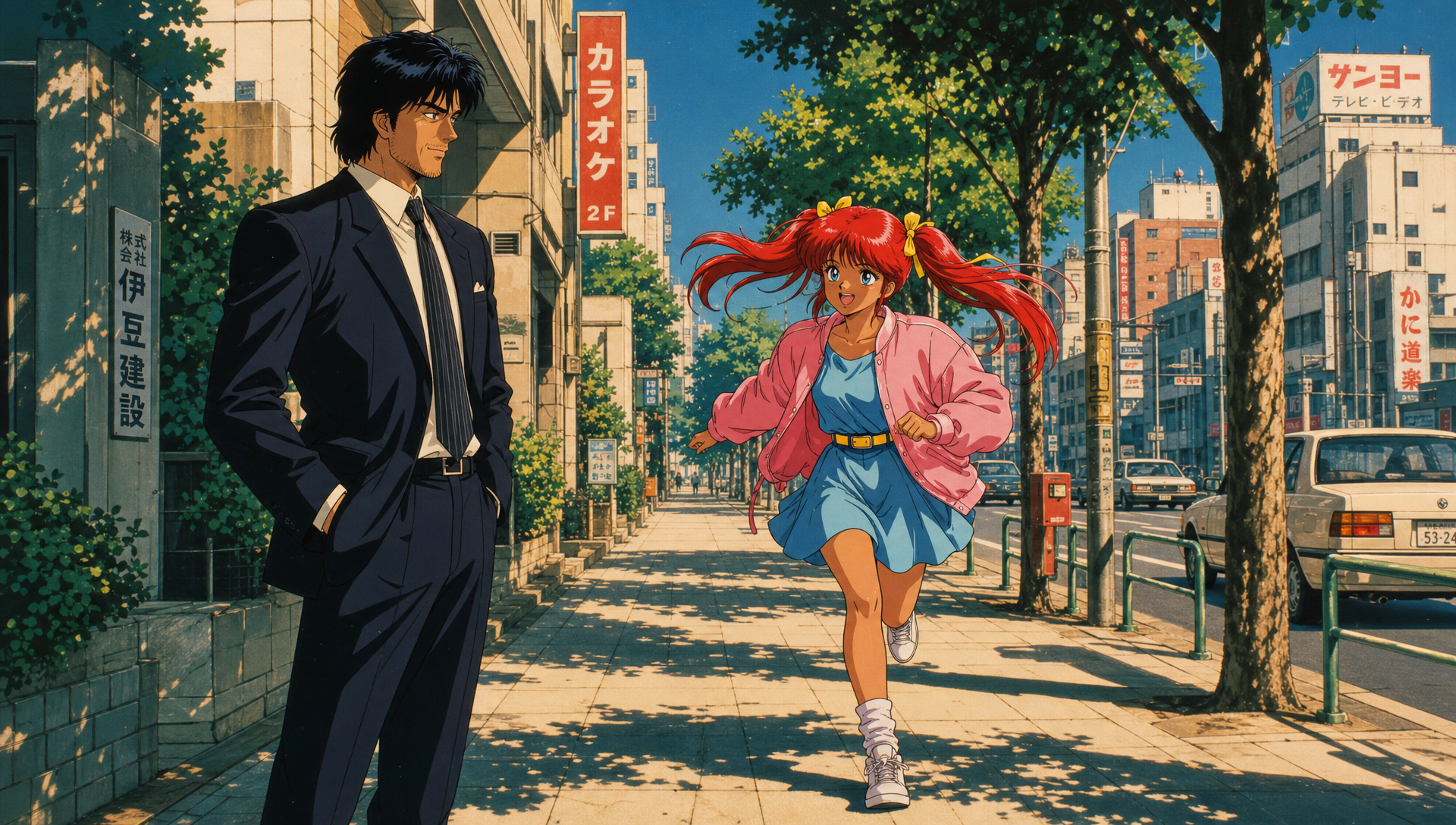
His voice was calm, measured, faintly paternal in the way he always spoke to me when I was seconds away from creating unnecessary chaos.
He stood—back straight, hands folded, suit immaculate despite the heat, looking less like a man waiting for lunch and more like a statue someone had temporarily placed on a Kyoto sidewalk.
“I was running,” I said, breath still catching.
“Yes,” he replied mildly. “That was observed.”
He inclined his head toward the entrance of the restaurant just a few meters away.
“We should go inside. You are currently ten minutes late.”
“Ten minutes is fashionable,” I said, fixing my ponytail again. “Fifteen would be worrying.”
“Your appointment began at twelve.”
“Details.”
We started toward the door together.
I straightened my blouse, smoothed my skirt, and tried to slow my breathing enough to look like someone who had arrived with dignity instead of sprinting through half of Kyoto.
“It’s going to be fine,” I said, mostly to the air. “I know this guy. Talent scout. Shun Tachibana. We met four months ago. He liked my voice, he liked the camera test. This lunch is basically a formality.”
“Yes,” he said politely.
“I mean, come on. I’ve got this.”
“Yes.”
“Totally under control.”
“Yes.”
I glanced sideways at him.
“You don’t sound convinced.”
“I am allowing you to finish reassuring yourself.”
I rolled my eyes and pushed the restaurant door open.
“Erika,” he said quietly before we stepped inside.
I paused.
“Your name,” he reminded me gently, “is Erika Takamine.”
I nodded.
“And this meeting,” he continued, voice calm as ever, “is an opportunity.”
I knew what he meant. Not the lunch. The whole thing. The hair. The singing. The auditions. The endless practice. The careful lies. The careful smiles. The year of learning how people here talked, bowed, ate, laughed, worried about trains, worried about rent, worried about the thousand invisible rules that held their lives together.
“If this opportunity is missed,” he finished, “everything becomes… significantly more complicated.”
I gave him my brightest, most confident smile.
“Then good thing I’m not going to miss it.”
Inside, my hands were still trembling.
Outside, Erika Takamine walked into the restaurant like she owned the next hour of her life.
I stepped into the restaurant ready for battle and found… silence.
A couple at the far table, a waitress polishing glasses, sunlight on empty chairs.
No Shun Tachibana.
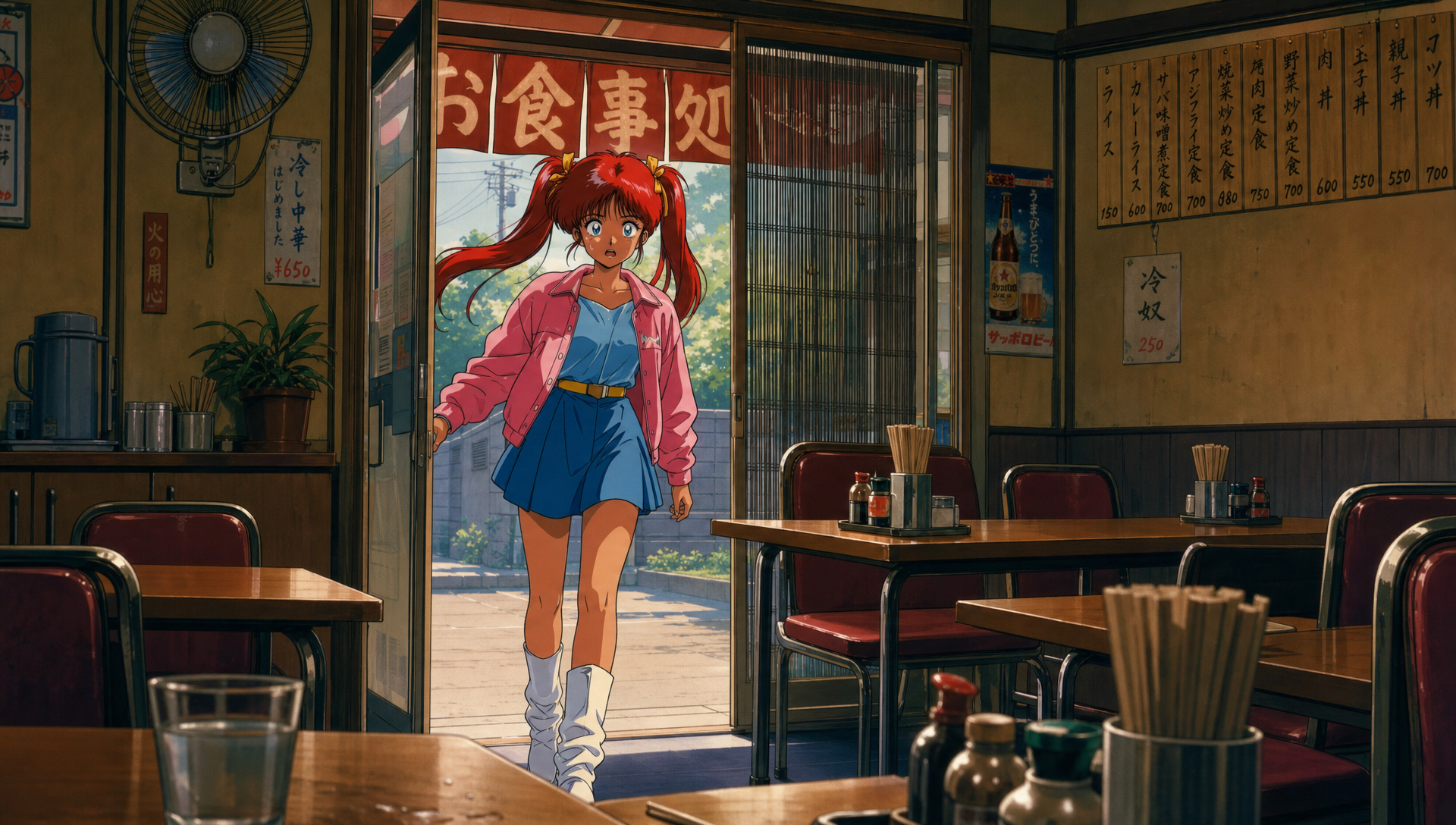
Just like that the fire drained out of me.
Ten minutes late became fifteen, then twenty, and my brain immediately began composing the obituary of my career: Local girl dyes hair, misses lunch, starves quietly.
I stood there staring at the room, already imagining rent notices and apologetic smiles to my landlord, when a voice exploded from behind me.
“ERIKA TAKAMINE!”
I turned and nearly collided with him.
Shun Tachibana burst out of the back corridor like a champagne cork in a tailored suit—bright smile, energetic bow, hands already moving as if he were conducting an orchestra.
“I am terribly, spectacularly late!” he declared. “My fault! Completely my fault! Traffic, chaos, destiny conspiring against us—but here we are!”
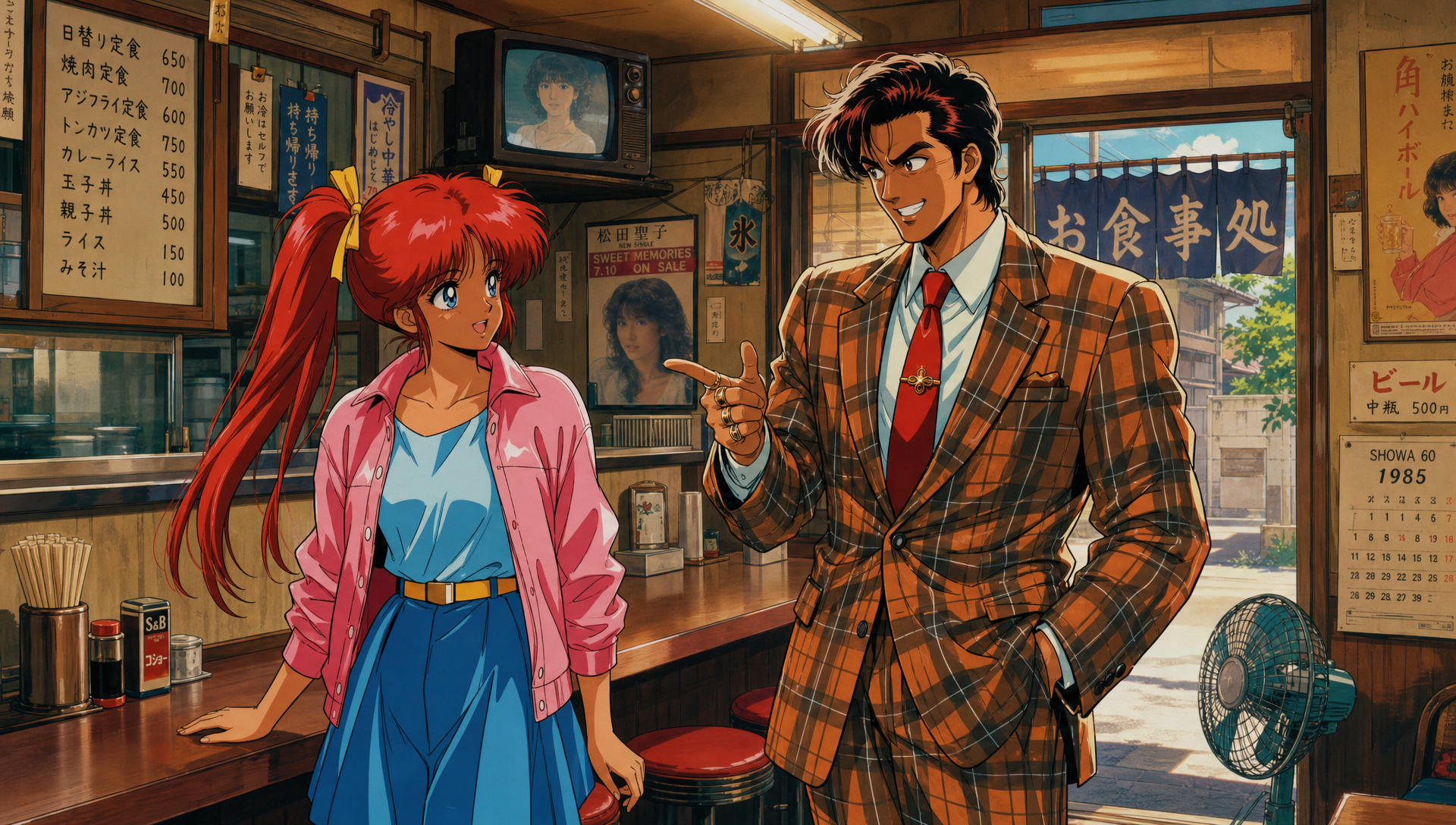
He clasped my hands like we’d just signed a world tour and swung us toward a table.
“Come, come! Sit! Today we talk about your future, and I promise you—what a future! Kyoto will remember this lunch, I guarantee it.”
Behind me, Sasaki followed with quiet precision while Shun kept talking at full speed, already selling me a dream as he pulled out a chair.
“Miss Takamine, I tell you—by the end of this year people will be arguing about where they first heard your name!”
I clocked Shun Tachibana in under half a minute.
Too loud. Too shiny. Too warm.
He leaned into the table. Hands everywhere. Smile everywhere. Voice everywhere.
Japan made polished little businessmen by the million; Shun felt like one that had just been dropped down a staircase, a Broadway’s staircase.
Sasaki stood beside my chair in perfect silence until Shun finally noticed him.
“Ah—your manager?” Shun said. “Please sit. This is lunch, not a police interview.”
Sasaki gave a small bow.
“I’m fine standing.”
“Impossible,” Shun said. “You standing there makes me feel guilty, and I don’t enjoy that feeling.”
I nudged Sasaki with my elbow.
“Sit down. You’re scaring the talent scout.”
Sasaki sat with mechanical precision. Straight back. Exact angle. No wasted motion.
Shun watched him for a beat, then grinned at me.
“I love this already.”
A waitress came by, and Shun didn’t even look at the menu.
“Three ramens,” he said grandly. “Best in the house. If we’re discussing the future of Japanese music, we do it properly.”
Sasaki said, “None for me.”
Shun blinked.
“You don’t eat ramen?”
Sasaki looked at him with the calm of a machine refusing a warranty extension.
“I don’t eat.”
Shun stared, then turned to me, decided not to ask, and came in so hard I almost admired it.
“We saw the tape. The label saw the tape. Two other agents saw the tape. Erika, you’re the one. You’ve got the face, the movement, the voice, the timing—most girls have one or two, you’ve got the full set. The songs fit you. The camera likes you. The audition was electric. How many years did you train for that?”
I lifted one shoulder.
“Ten months.”
He froze.
“Ten months?”
I smiled.
“A little less, maybe.”
He slapped the table.
“That’s insane. That’s natural talent. That is exactly what this business prays for and almost never gets.”
He was fully airborne now.
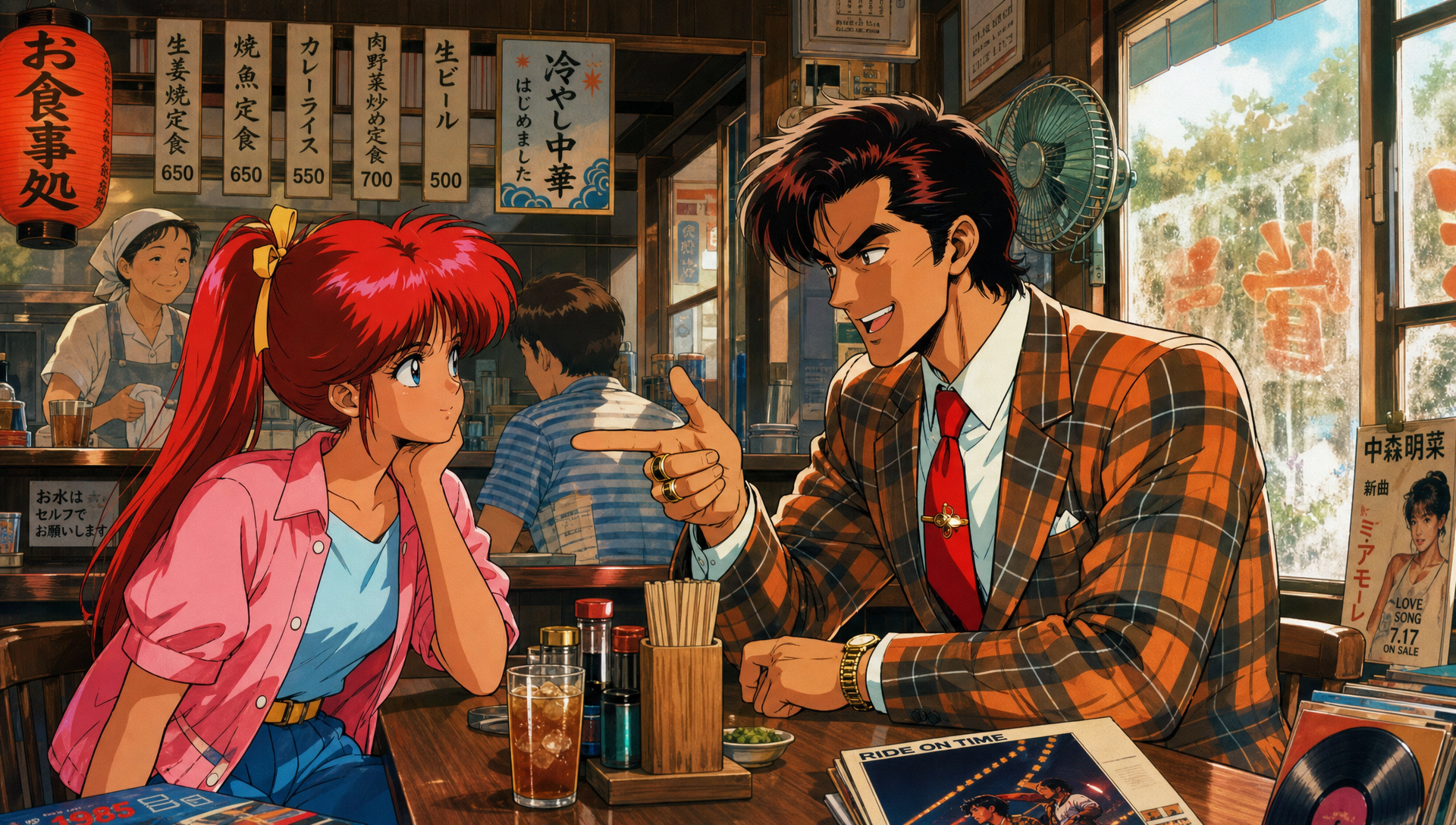
“Nineteen eighty-five, we build the foundation. Recordings, lessons, photo shoots, small appearances, television, the first single. Then nineteen eighty-six—boom. Launch year. Better stages. Better slots. Better money. We put you in front of the right crowd and let the country do the rest.”
He said it like he was unveiling a rocket with my name painted on the side.
And for half a second—just half—I could feel it, the pull of it, the clean bright shape of the lie.
I must have looked a little too dazzled, because Sasaki’s hand moved, light and flat against the table between us, like a quiet brake pedal.
Then the ramen arrived. Three bowls the size of washbasins. Vast, steaming, ceremonial. And utterly desolate. No egg. No pork. No greens. No color. Just noodles, broth, and despair.
Then, right in the middle of all that fireworks, Shun slid the contract across the table with two fingers and a smile.
“Now,” he said, lowering his voice like he was letting me in on something elegant and important, “this is only the starter arrangement. Very modest. Very normal. Base support, small guaranteed money, payment per record, promotional work, commercial appearances if things move nicely. Nothing to get hung up on. At this stage, what matters is momentum.”
I looked down. Sixty thousand yen a month. Just enough money to call survival an opportunity. Just enough glitter to make the pocket change shine.
The number sat there on the page looking much smaller than the way he’d said it.
Shun kept talking, of course.
“Retainer only,” he said, tapping the paper lightly. “Just to get the machine turning. Then recordings, appearances, bonuses, all the rest comes on top. You don’t look at the seed and complain it isn’t already a tree, right?”
I smiled politely.
Inside, the whole thing landed with a quiet little thud. Not because it was insulting. That would have been easier. Because it was almost plausible.
I glanced sideways at Sasaki. He was already looking at me. Not surprised. Not offended. Just measuring.
I put my fingers on the edge of the contract.
“I’d like to take a closer look.”
Sasaki’s eyes shifted once to the page, then back to mine.
I gave him the smallest nod. He answered with one of his own.
Sasaki leaned in at last. Not much. Just enough to put one hand on the table and shift the temperature of the meeting.
“The label’s name,” he said, “is Kiseki Records.”
Shun smiled.
“That’s right.”
“Kiseki Records is owned by Sunset Music.”
“Yes.”
“Which is owned by the Yamada Group.”
Shun’s smile held.
“Also yes.”
Sasaki looked at him without blinking.
“The owners of the Yamada Group were murdered this year,” he said. “And current street expectation is that the holding may be broken apart. If that happens, the parent company, its subsidiaries, and labels like Kiseki Records may be liquidated for pocket change.”
For one second, I thought that might do it.
It didn’t.
Shun lit up.
“Ah,” he said, pointing at Sasaki like he’d just seen a good card hit the table. “Now this is negotiation. I like this. You checked your sources. Good. Very good.”
He leaned forward, smiling wider.
“Yes, it’s true. Terrible situation. Tragic. Ugly. But that is way up there.”
He waved a hand vaguely toward the ceiling, as if the Yamada Group lived somewhere above the clouds.
“A label like Kiseki is far below that level. Very far. We are part of the structure, yes, but not tied to the fate of the whole thing in any immediate way. Business is business. These things happen at the top all the time.”
I tilted my head.
“So they do care,” I said, “or they don’t?”
Shun turned to me with the kind of grin men used when they intended to answer a different question.
“What matters,” he said smoothly, “is continuity.”
Then he swung back to Sasaki before I could stop him.
“And anyway, new management is already coming in. That much I know. They’ve already made it clear they intend to keep the music branch stable. Same recording lines. Same policy base. Possibly better. Honestly?”
He tapped the table.
“Possibly much better.”
Sasaki said nothing. Which, with him, was never a good sign.
Shun kept going.
“The Yamada Group is not some little storefront operation. They’ve been there since the war. Institutions like that do not simply vanish overnight. They reset. They restructure. They survive.”
He spread his hands, smiling like he was unveiling the future itself.
“And music matters now. More than ever. The eighties are being shaped by it. This generation runs on it. Pop, rock, image, television—it’s all one machine now. The new people coming in will understand that. They’ll fix the weak parts, invest where it counts, and make the whole brand grow and glow. Glow and grow.”
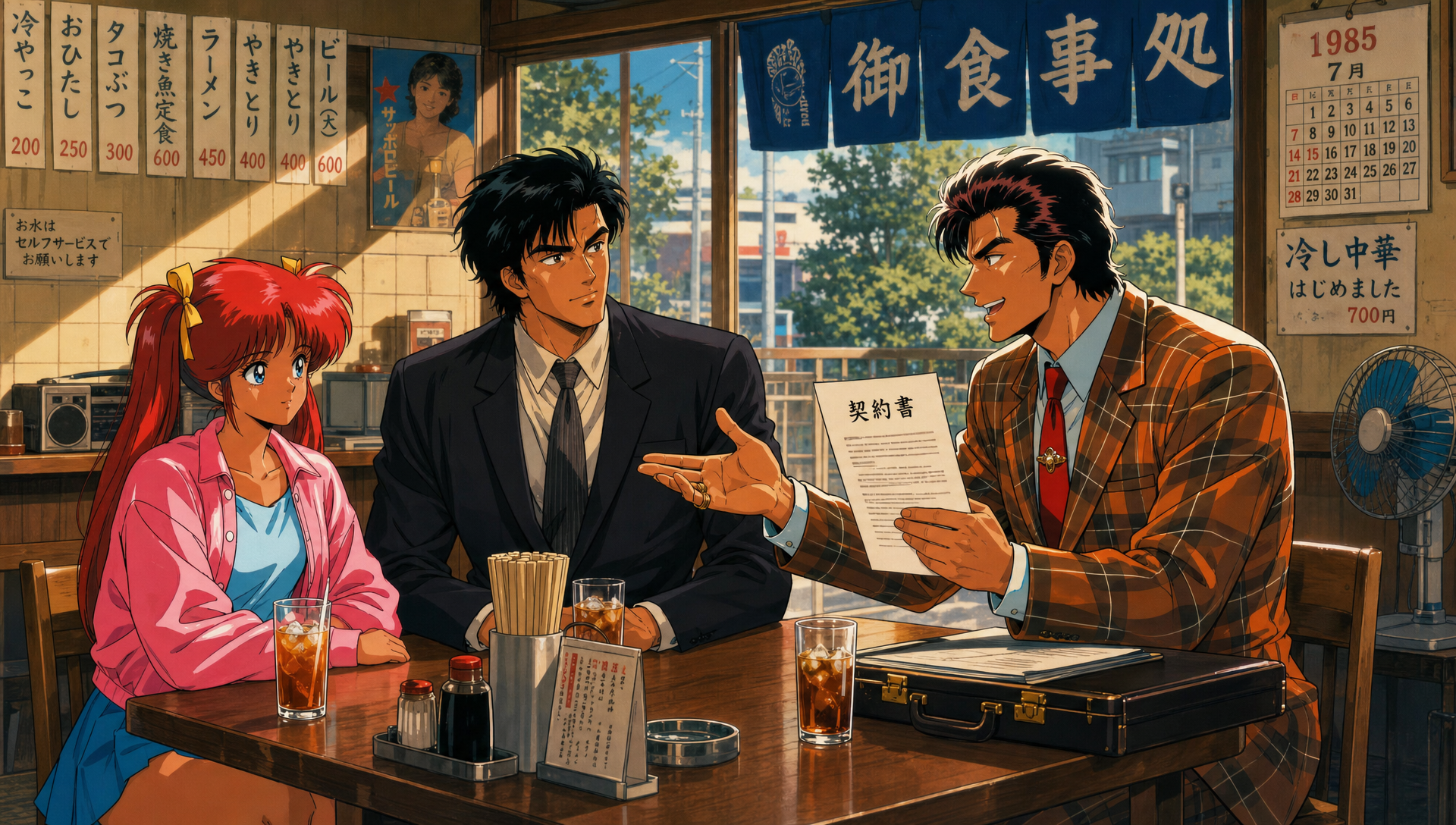
He tapped the contract once more.
Shun lifted a finger, smiling like he had just remembered the final card in a magic trick.
“And besides,” he said, “Reika Yamada is taking over. Young. Talented. Sharp. Exactly the kind of new blood a group like this needs.”
Sasaki cut in before he could build a stage under the sentence.
“And she has been running with a biker gang between Tokyo and Osaka,” he said. “Some say that is exactly why the owners of the holding were killed. Possibly with shareholder encouragement.”
That landed between them with all the warmth of a knife on glass.
Sasaki pushed the contract back across the table with two fingers.
“We want twenty percent more on the base pay,” he said. “A signing bonus. And a startup allowance.”
Shun looked down at the paper, then up at us. And smiled. Not offended. Not rattled. If anything, happier.
“Yes,” he said, nodding fast. “Okay. Good. Good. This is real negotiation. I respect that. I do. Look, maybe she’s all those things, maybe not, but that is exactly the point. That is exactly the point.”
He tapped the table, warming up all over again.
“The air is changing. The old polished stuff is dying. Music needs edge now. More attitude. More danger. More rock and roll. If the new management has any instinct at all, they’ll lean into it.”
He spread his hands and gave me a bright, expensive smile.
“I can’t do twenty percent on the base. Not today. But”—he lifted one finger—“I can add a little signing bonus, payable at the end of the first month, once everything is in motion.”
He tilted his head.
“What do you say?”
I opened my mouth.
Sasaki cut across me again.
“Before she signs anything,” he said, “who else is on the Kiseki label?”
Shun turned to him with a delighted smile, like this was exactly the kind of question he’d been hoping for.
“Oh, now we’re talking,” he said. “Kiseki Records has taste. Real taste. Erika here wouldn’t be joining nobodies. She’d be standing beside serious talent. The best of the best.”
He lifted a finger.
“For example—Stella Marina. Directly out of the United States. Signed for the Japanese market this year.”
I turned at once.
“Stella Marina?”
Sasaki didn’t even look at me.
“Italian-American prima ballerina turned singer,” he said flatly. “One successful single -A Feeling- in the US. After that nothing of note.”
That cooled me faster than the tea.
Shun refused to let the air die.
“Yes,” he said, nodding, “and that is exactly why it’s interesting. International face. Hybrid image. Cross-market appeal. But that’s not all. We’ve got new stars coming up too. Real new blood. Japanese girls. Fresh. Hungry. The next wave.”
He pointed lightly toward me.
“Girls like Erika. Girls who can carry a new era.”
He leaned in again.
“We’ve got one rising right now—Saki Sawajima. One hundred percent raw charisma. Total breakout potential.”
Sasaki moved in without changing expression.
“Family works in motorsports but her father disappeared two years ago,” he said. “She sings with a garage band. Local circuit. Former paddock girl gone bad. Unstable profile.”
Shun slapped the table once.
“Rebel,” he said. “That’s the word. Rebel with baggage. That’s the attitude.”
He pointed between the three of us as though the whole argument proved his case.
“That’s exactly what I mean. We’ve got the foreign veteran coming in from abroad, we’ve got rough local fire—”
Then he turned to me, smiling like he was placing the final piece on the board.
“And then there’s Erika. Clean face. Cool face. Perfect name.”
Sasaki leaned in a fraction more.
“Erika is talented. We won’t have trouble finding other offers. Twenty percent extra on the base,” he said, “or we walk.”
Shun put a hand to his chest like he’d just been shot.
“No one can do that,” he said. “That’s not negotiation, that’s—”
He searched the air for a word dramatic enough.
“That’s violence.”
Sasaki didn’t blink.
“You’re dried up on singers, you don’t have an office,” he said. “The Kiseki label doesn’t have an office. Right now it’s just you a faded italo-american meteor, a garage girl and whatever is in that bag.”
Shun opened his mouth.
Sasaki kept going.
“Isn’t it?”
A beat. Then Shun snapped right back into the light.
“Twenty percent is perfect,” he said at once, like it had been his idea all along.
He turned to me with that same bright salesman’s grin.
“What do you say, Erika?”
I looked at him. Then at Sasaki.
Sasaki looked back at me once, calm and unreadable as ever.
We gave each other the smallest nod.
I smiled.
“I accept.”
Shun let out a noise halfway between a laugh and a victory cry.
“Yes!”
He pushed the contract toward me at once.
“Excellent. Smart decision. Very smart.”
I took the pen. Then stopped.
“There is one thing,” I said.
Shun froze again, though only for a second.
“Of course. Anything.”
I touched the line where my name was written.
“I don’t want to use this name.”
Sasaki’s eyes shifted to me.
Shun blinked.
“You mean… a stage name?”
I looked up.
“Do you mind if I choose one?”
“Mind?” Shun said. “I encourage genius. What’s the idea?”
I held the pen between my fingers and said it simply.
“Eden.”
For the first time that entire meal, Sasaki moved like something had actually reached him. Not much. Just enough.
“Eden,” he repeated.
I turned to him.
“Yes.”
Shun stared at me for half a beat. Then his whole face lit up.
“That’s perfect,” he said. “Perfect. Pure. Clean. Biblical. Memorable.”
He tapped the contract excitedly.
“That is exactly the face, exactly the sound, exactly the kind of name that sticks. Erika, no—Eden, you’re a genius.”
He pushed the papers closer, almost bouncing in his seat.
“Go on, sign. Let’s enjoy the noodles. This is going to be amazing. We’re going to do great things. Really great things.”
I looked at Sasaki one last time. He said nothing. Neither did I.
I signed.
Across the table, Shun was already grinning at the future.
Beside me, Sasaki and I exchanged one quiet look over the steam of noodles, broth, and despair.