
Italy Arc — Chapter 05
Quality Coffee
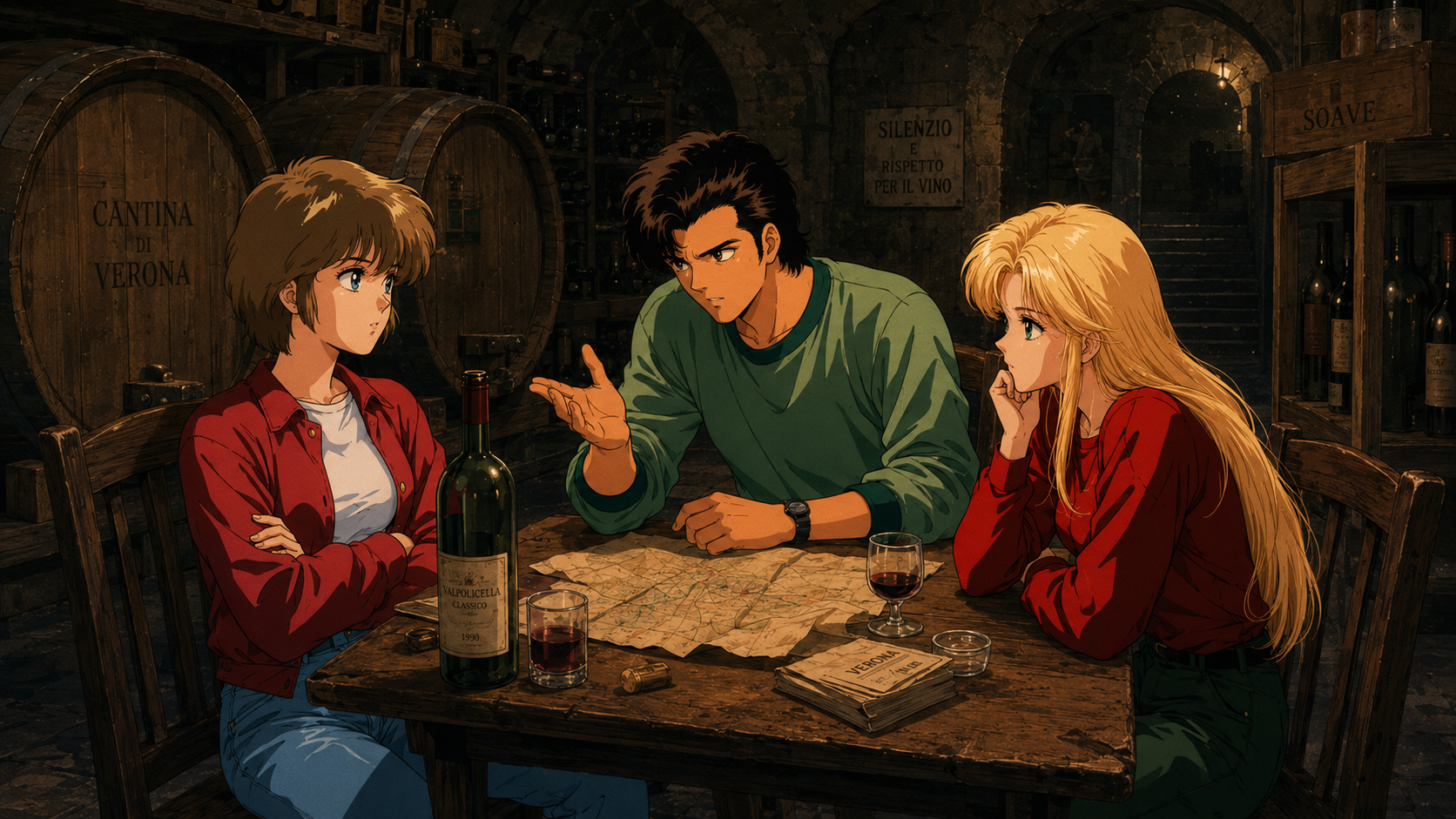
The streets of Verona whispered under our feet. The lanterns were already lit, casting gold on stone. This part of the city always felt like it was folding in on itself after dark—wide piazzas collapsing into crooked alleys, the chatter of cafés fading behind shuttered doors.
I walked between Renzo and Sylvie, the soles of my flats tapping against the wet cobblestones. Steady. Not fast. But forward.
Then we turned another corner, and I felt it. Something off.
“This can’t be right,” Sylvie muttered, pulling her jacket tight as the wind funneled through the narrowing lane. “Did we just wander into 1943?”
Renzo squinted at the scrap of paper in his hand. “He said Café Edera. Near the Arena.”
Except… there was no café. Just a narrow alley, wedged between a bakery that had long since surrendered and a trattoria missing half its roof. At the end of it stood a faded green door, paint curling like old bark. Above it hung a wooden sign that might have once said Osteria Edera, now barely readable except for the shadow of a vine.
Sylvie shot me a look. “This place screams ‘hideout,’ not espresso bar.”
I tried to laugh. I really did. But something cold was coiling under my ribs. It wasn’t fear—not exactly. It was the feeling of crossing a line. Of entering a space not meant to be seen.
Renzo pushed the door open. It groaned like a warning.
It was dim inside. The air smelled like wet wood, wine barrels, and old dust. The light was the color of old amber, flickering through cracked bulbs. Wooden beams sagged above us. The floor creaked. It felt like we’d stepped into a room that hadn’t changed in fifty years—and didn’t want to be disturbed.
From the back of the space, a figure rose from a trapdoor—lean, wiry, in a cap and wool vest that looked like they belonged to another century. He eyed us without expression. Not unfriendly. Just… practiced.
“Buonasera,” Renzo said.
The man responded in thick dialect—fluid, fast, something that twisted through the air like a local spell. Renzo replied with a hint of the same rhythm, and I watched something invisible pass between them. He waved us toward a table.
Sylvie leaned against my shoulder. “What’s going on?”
“He’s checking if we’re the clients,” I whispered, even though I hadn’t understood the words. I didn’t need to. I could feel it. There was a script unfolding, and we were already inside it.
Renzo returned. “He said to wait in the back. The guy we called sometimes meets people here.”
Sylvie raised her eyebrows. “Meets people? What is he, a spy?”
“I didn’t ask.”
The old man disappeared into the floor again with a grunt and the scrape of stone. Renzo motioned for us to follow, and we stepped through a low arch into the back. The floorboards groaned.
The room beyond was barely more than a brick alcove—crates, a rusted stove, and mismatched chairs scattered like an unfinished poker game. A single bulb swayed overhead.
I stepped in first. Ran my hand across the surface of a crate. Dust clung to my fingers like memory.
“Well,” I said, voice lighter than I felt, “at least it’s private.”
Renzo didn’t smile. He sat. Closed the door. “He said the guy’s coming soon.”
I sat down beside him. Hands folded. Heart racing quietly beneath my ribs.
This wasn’t a café. This wasn’t a coincidence. The whole place felt like a scene built for a secret—the kind of place that existed just enough to vanish again after you left.
And still, I was here. I wasn’t turning back. Not anymore.
We had been waiting in that dim back room for what felt like a week squeezed into forty minutes. Renzo glanced at his watch again.
“If he doesn’t come in ten minutes, we leave. I am not dying behind a wine barrel.”
Sylvie rubbed her arms. “If we do die here, at least we’ll be well-aged.”
I gave a small, tired smile, swinging my legs from the crate I was sitting on. “Not sure I’m vintage enough yet.”
The room wasn’t much—just stone, low ceilings, a crooked coat rack in the corner, and an air of dust and dampness. The only light came from a wall sconce flickering above a stack of mismatched chairs.
Time passed slowly. We broke into low, exhausted laughter—the kind that feels a little too loud in a quiet place and a little too close to crying.
Then the door creaked open. We all fell silent.
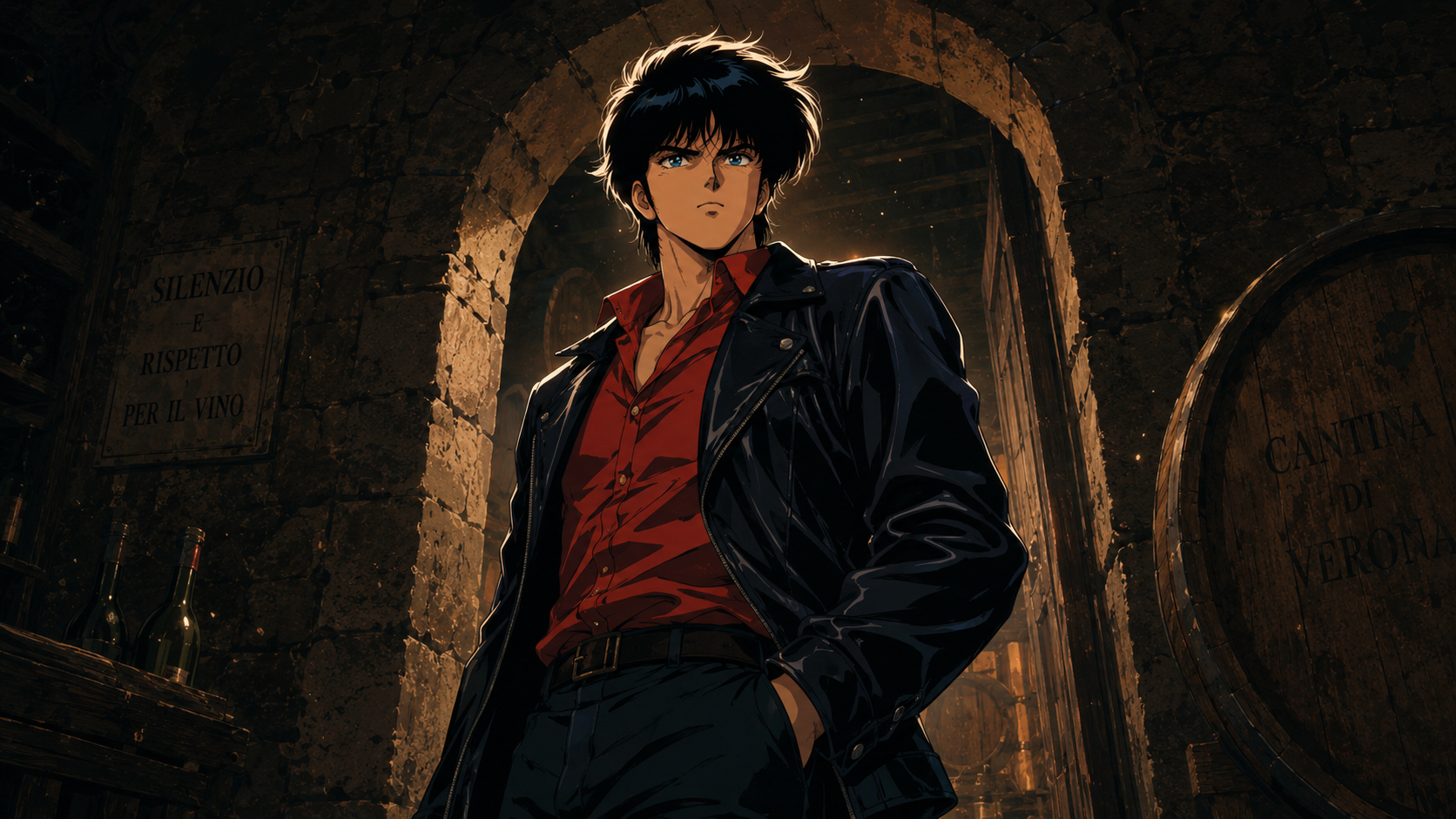
And he stepped inside.
He didn’t so much enter as arrive, his silhouette framed by the faint glow of the front room. Tall, lean, a black jacket slung open over a deep red shirt that clung just enough to hint at muscle. The jacket—scuffed at the cuffs, creased at the elbows—looked lived-in, not staged. Like him.
His sleeves were pushed up halfway, revealing strong forearms and a faint network of old scars barely visible in the light. His hair was dark, short, and tousled—not the artful mess of magazines, but the kind that said slept five hours, dodged a punch, didn’t care.
His eyes scanned like a city street at midnight—casual, but always aware. He didn’t dress to impress. He dressed like someone who might vanish at any moment—but you’d still remember.
Sylvie visibly exhaled. “Oh my God.”
The man scanned the room once—his eyes dark, quick, assessing. He spoke in Italian, voice smooth, but edged with iron.
“Sei tu Renzo?”
Renzo, suddenly very much humbled, stood. “Sì. Grazie per essere venuto. Lei è la cliente.”
The man nodded once, then turned his gaze to me. His eyes landed on me with a focus that made my spine straighten.
“Yes,” I said, keeping my voice composed despite the tension threading through the room. “I’m the one going to Tokyo.”
He didn’t respond, just gave a slow nod before turning to the crooked coat rack by the door. With deliberate movements, he removed his jacket and hung it up. The sconce caught the smooth fabric of his undershirt, revealing a strong, tapered torso. Every inch of him looked precision-made, carved from the edges of shadows and purpose.
Sylvie made a small, involuntary noise beside me. “Well, damn,” she muttered under her breath.
He took a seat without invitation, hands folded on his knee like a man used to being in control of a room without effort.
“Go on,” he said.
I hesitated for half a breath, then started. I told him everything—about my childhood home, the bureaucratic mess, the pressure from my director, the threatening letters. The paranoia. The weight I’d been carrying for months.
My voice stayed measured, but I meant every word. He didn’t interrupt once. His eyes stayed on me—brows still but not indifferent, like a clock hand frozen just before midnight.
When I finished, silence settled over us.
A moment later, the tavern owner appeared with four slightly chipped cups of coffee, placing them carefully on the table. The man took his without thanks and drank it all in one tilt. Then set it down.
“No,” he said flatly.
Renzo blinked. “Wait—what?”
Sylvie sat up straighter. “What do you mean, no?”
He stood as calmly as he’d sat. “Find someone else.” He said in a crisp English.
“But why?” I asked, unable to keep the surprise from my voice.
His expression didn’t change. “Nothing about that story requires me. I have better things to do than to babysit a kid.”
Sylvie raised her hands. “Okay, look. She just needs someone to make this legit—someone tough. You look the part. You’re practically the prototype.”
He didn’t respond. He was already turning, long strides carrying him toward the door.
I moved before my mind could protest. My hand shot out, brushing his wrist. Just enough pressure to stop him mid-step.
The world stilled.
He froze like he’d been hit by lightning, gaze fixed straight ahead—but everything about him tightened, like a coil bracing to strike. For a moment, even the air seemed to hold its breath.
Renzo’s mouth went dry. “Natsumi…”
Sylvie’s voice was barely a whisper. “Oh my God. He’s gonna kill us.”
The man looked down—slowly—to where my fingers rested against the inside of his wrist. He didn’t move. Didn’t yank away. And still, nothing happened. Only the flicker of something behind his eyes. A memory, maybe. A hesitation.
I didn’t flinch. My voice came quiet, steady.
“Please.”
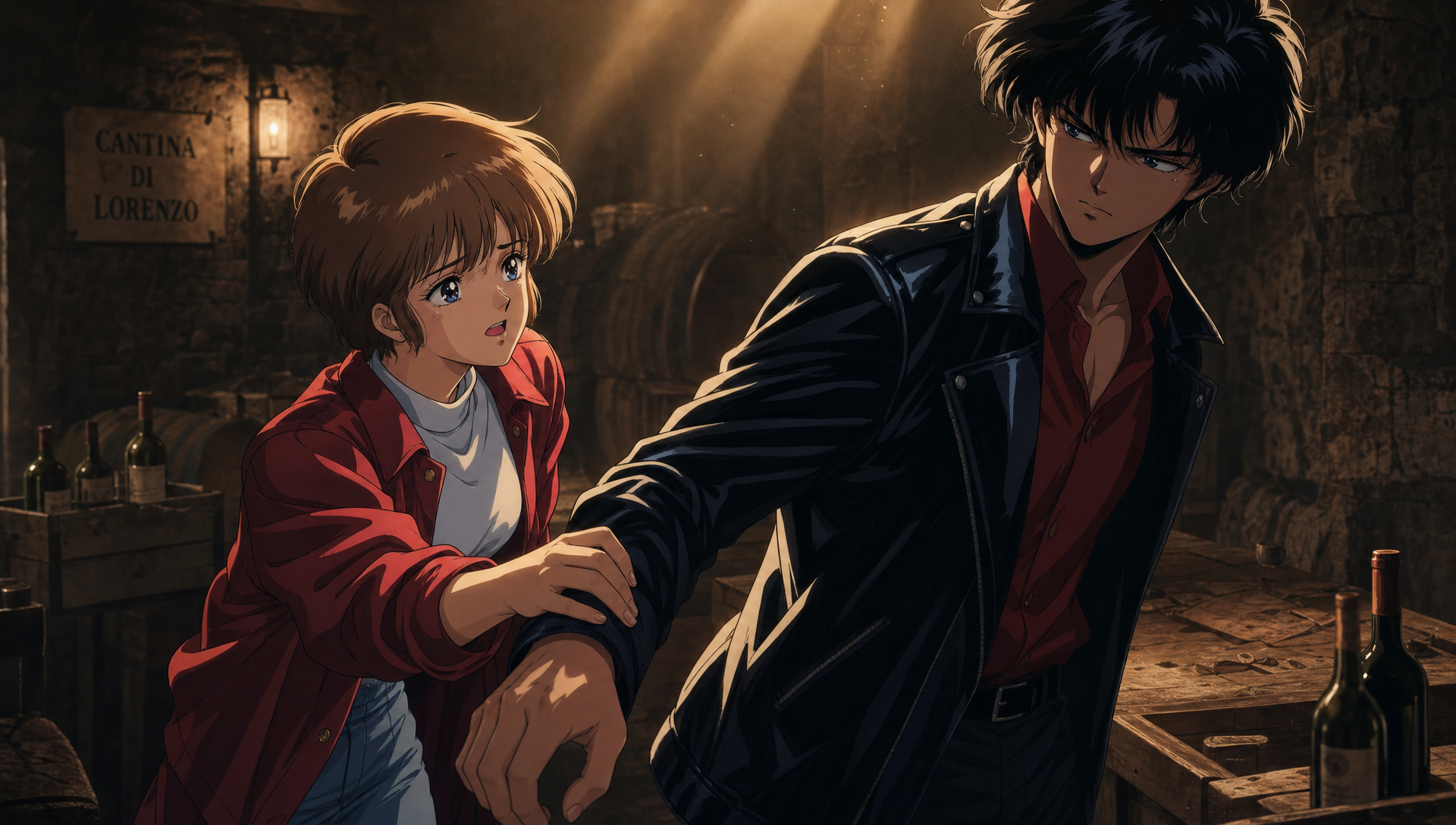
His jaw clenched. His eyes found mine. Then at last, he spoke. The words slow, like they’d been dragged up from somewhere deep.
“Due milioni di lire.”
The breath we’d all been holding escaped at once. Renzo nearly fell back in his chair. “Two million?” he muttered. “You’ve got to be kidding me.”
But the man didn’t smile. Didn’t gloat. He simply pulled free—not harshly, just enough to reclaim the space between us.
“You want it done properly, that’s the price.”
I stared at him, startled—but not deterred. My heart was hammering in my chest. I gave a nod.
“Then I’ll pay it.”
His lips parted just slightly. Whether in surprise or something else—approval, maybe—was impossible to tell. He leaned back again, exhaling once through his nose, and reached for the coffee on the table.
“Good,” he said. Then, with a pivot of the shoulders, he turned toward Renzo. “Portami tutti i documenti,” he said, calm but firm. “Contratto della compagnia. Contratto della cliente. Copie delle lettere. Con la mia licenza, sarà tutto legale.”
Renzo nodded quickly, clearly relieved we weren’t about to die after all. “Certo. Domani li preparo.”
Then the man turned back to me. His eyes narrowed—not unkindly, more like someone trying to figure out how I’d just unraveled his decision with a single touch. His mouth curved into the barest hint of a smirk.
“You’re an annoying brat,” he said plainly. “But… I’ll help you.”
Sylvie let out something between a swoon and a gasp, swatting Renzo’s shoulder. “Did you see that? Did you see him smile?”
“Barely,” Renzo muttered, eyes still half-wide.
Still catching my breath from the moment before, I allowed a crooked smile to answer his.
“I’ve been called worse.”
“I don’t doubt it.”
He stepped back, checking his cuff again like this was just another case, another job. But something had shifted in the air—an acknowledgment, unspoken, that the wheels were turning now.
“Be in front of the Edera,” he said. “Morning of the departure. Six sharp.”
I gave a firm nod. “I’ll be there.”
Then, after a breath, I added, “And… your name?”
He tilted his head slightly, as if considering whether to answer. Then, with a deliberate glance toward me, he said.
“Since you’re Japanese, and we’re going to Tokyo… you can call me Ryōji.”
Sylvie blinked. “Ryōji? That doesn’t sound Italian.”
“It’s not,” he replied dryly.
She squinted, leaning forward. “But you don’t look Japanese at all.”
He looked down at the spot where I’d grabbed his wrist. For a heartbeat, it seemed like he might shrug us off and walk away anyway. But instead, his shoulders eased. Barely.
“I’m not Japanese,” he said, voice lower now, like confessing something that didn’t matter anymore. “But I speak the language and often work there.” He met my eyes. “Ryōji will do.”
It wasn’t a full answer. It wasn’t even a real name. But it was permission. And that was enough.
I lit up. “Thank you—thank you so much!” I said, the words spilling out faster than I meant them to. I bowed—quick, awkward, grateful. “I promise I’ll get you everything you need!”
Renzo reached out like he thought I might faint or try to hug the man. “Natsumi—maybe give him a little breathing room?”
Sylvie, meanwhile, looked like she’d forgotten how to breathe altogether.
Ryōji glanced at them both, something like reluctant amusement tugging at the corner of his mouth. Then, in a tone just a few shades warmer than steel, he added,
“Drink the water. And the coffee. The owner gets offended if you leave them untouched.” A pause. Then he nodded once, almost curt. “It’s on me.”
We all blinked.
“Wait, seriously?” Sylvie asked, blinking. “You’re actually… kind of sweet?”
He gave her a flat look, then turned to me again. “Front of Edera. Day after tomorrow. Six in the morning. Don’t be late.”
And with that, he gently pushed me back a step—not harsh, just enough to make a point. “Now stop clinging.”
I replied, flustered. “S-Sorry!”
Renzo, finally recovering, raised a hand. “Wait, wait—do you have a contact? A card? Anything? How do we actually… pay you?”
Ryōji tilted his head, just slightly. “I’ll come collect after the job’s done,” he said simply. “If you want paperwork, I can draw something up. But I’m not pressing you for a down payment.”
Sylvie murmured under her breath, “Mysterious, morally flexible, and debt-tolerant? I might die.”
Ryōji acted like he hadn’t heard her, already halfway to the door again.
Renzo gave me a side glance. “You sure about this?”
“No,” I said, eyes still on the door. “But I think he is.”
And then he was gone.
The coffee steamed gently in its chipped cup. The water was untouched. And for a moment, none of us moved.
Then Sylvie lifted her glass, took a sip, and whispered, “He really does have excellent taste.”