Interlude 03 — Chapter 02
Summer Breeze
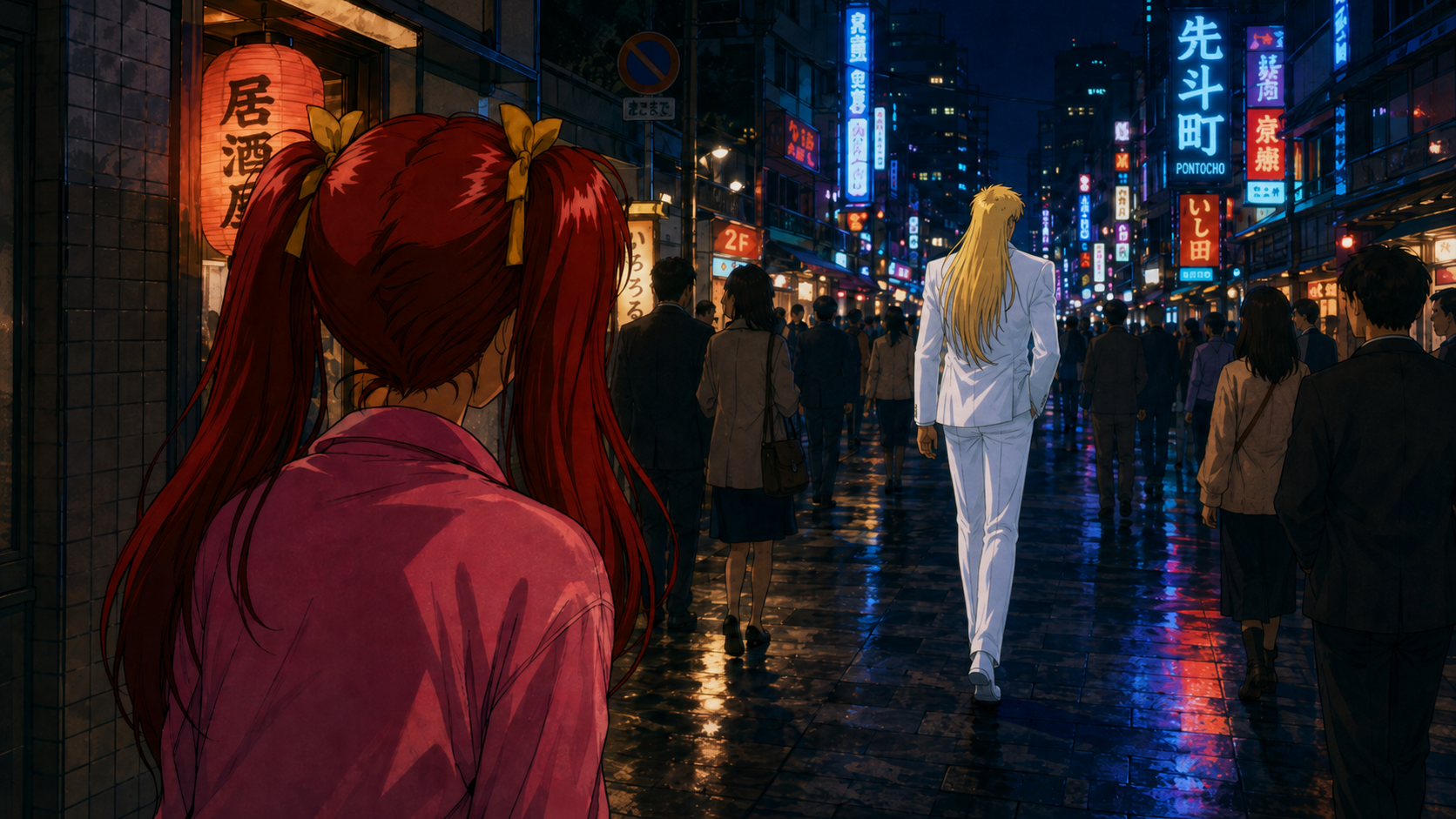
I packed up fast, the way you do after a set when the next act is already circling the stage like a replacement heartbeat. Cables, bag, ribbon check, one last glance at the room, then out.
Behind me the live house was already swallowing the next artist whole—new soundcheck, new feedback, new little emergency pretending to be culture.
Sasaki peeled off to find Shun and arrange whatever disaster came next on my schedule, which left me with a brief, miraculous pocket of freedom. Not much. Just enough.
I slipped down the side corridor, out through the alley exit, and managed to shake their line of sight for once—no manager, no handler, no hovering concern, just me and the night air and the immediate, holy need to eat something before I collapsed into decorative rubble.
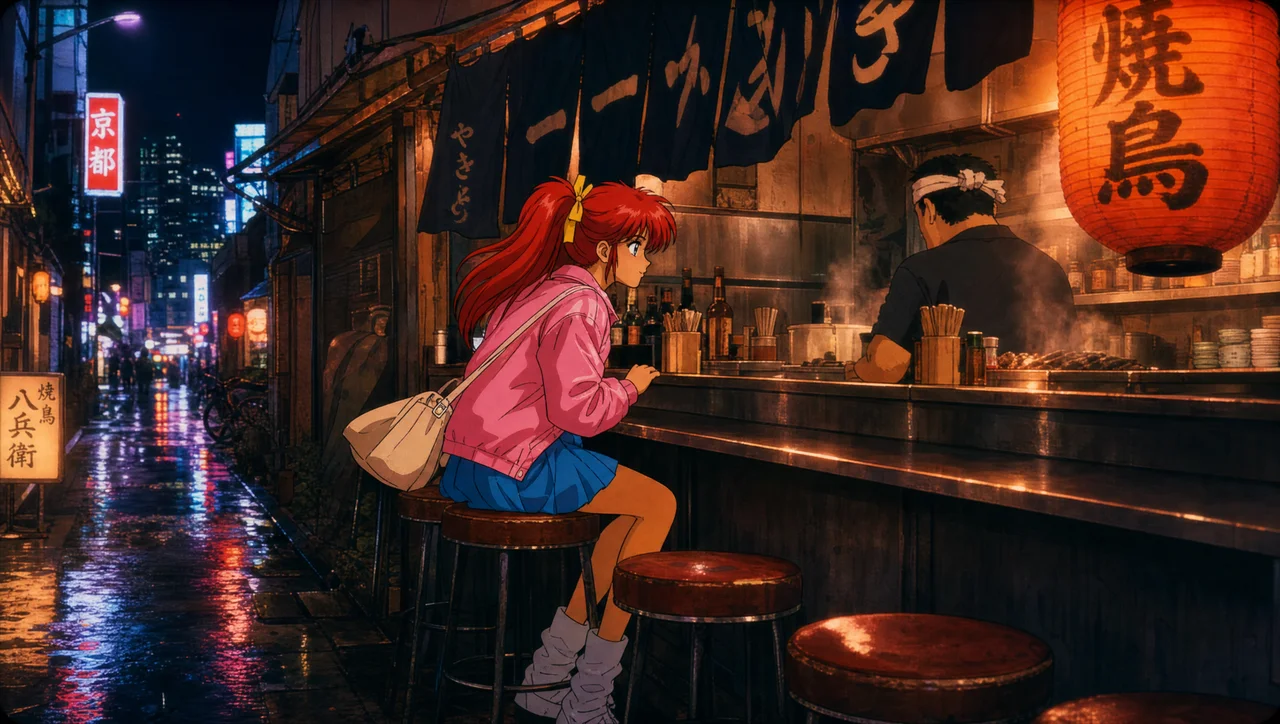
The stall was where it always was, half tucked into the street like it had grown there out of steam and stubbornness. Yellow light. Metal counter. A row of stools polished by years of tired people and cheap hunger.
I ducked under the noren and slid onto one of the seats in a single practiced motion, dropping my bag at my feet with the urgency of someone fleeing war.
“Hi, Junpei! I ain’t got much time and reeeeaaalllly need a bite,” I said, already bouncing once on the stool as if speed might cook faster.
It came out bright and breathless and far too familiar to be new.
Which, of course, it wasn’t.
Junpei looked up from behind the counter with the long-suffering face of a man who had watched me storm in like this often enough to classify it as weather.
It was obvious at a glance that I was a regular here. The stool knew me. The steam knew me. Junpei definitely knew me.
What I did not know was the figure standing—or rather, impossibly, elegantly existing—on my left.
The man from before.
Tall. Blonde. Handsome wasn’t the word. Beautiful was worse and therefore more accurate. Flowing golden hair, perfect posture, perfect suit, and the kind of stillness that made everyone else in the stall look like rough sketch lines around a finished painting. He sat there with a glass in one hand, sipping whatever it was with insulting class, as if street-side food stalls regularly catered to moonlit aristocrats and I had simply failed to notice until now.
My brain, normally so quick in emergencies, immediately became decorative.
Don’t stare.
Obviously I stared.
Not directly. Not continuously. Just in tiny panicked fragments, the way one checks whether a fire is still burning and then regrets finding out it is. Hair. Jawline. Hand. Glass. Collar. Nope. Back to the counter. Absolutely normal. Entirely composed. I had survived bad crowds, bad contracts, and Shun Tachibana. Surely I could survive one beautiful stranger sitting three feet away without turning into a malfunctioning schoolgirl.
Then he looked at me.
And smiled.
Silently.
Oh, good, I thought. Excellent. Wonderful. My night is over.
“Junpei,” I said quickly, with the determined brightness of a woman trying to save herself through carbohydrates, “tell me you’ve got something hot, salty, and emotionally stabilizing.”
Junpei didn’t even look up from the grill. “You say that every time.”
“Because every time, I mean it.”
I reached for the water glass like it had diplomatic importance and took a sip I absolutely did not need. Beside me, golden catastrophe continued to exist in perfect silence. Fine. Good. We were all being normal.
Then I leaned forward on my stool, lowered my voice just enough to pretend I wasn’t trying to gather courage through conversation, and smiled at Junpei.
“You’re very talented” the golden perfection beside me said.
He said it with absolute confidence, in a voice so smooth and firm at once it felt less like sound and more like something the world had agreed to obey.
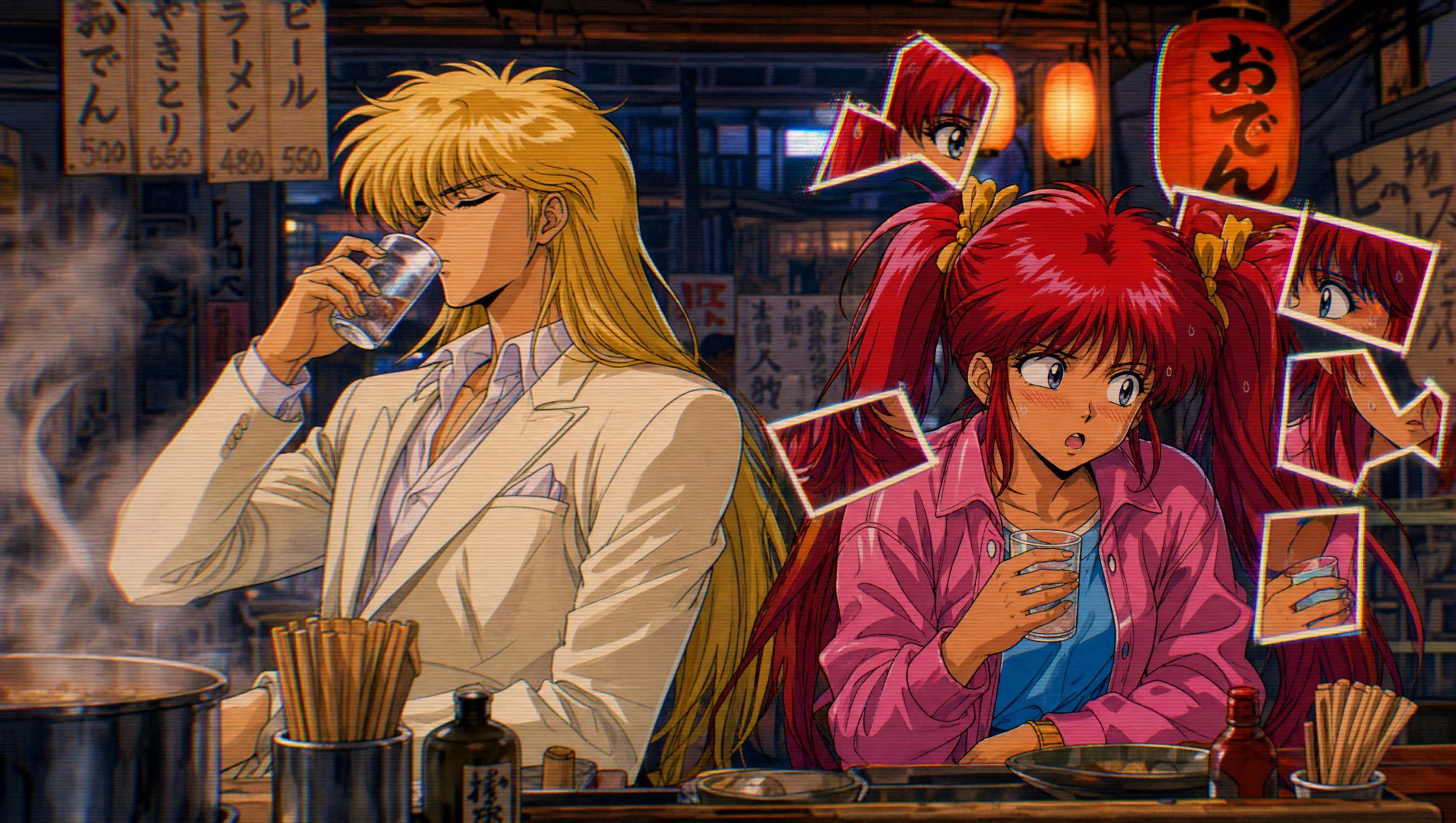
For one impossible second, I had the distinct impression that the whole universe had paused to listen to him speak.
“Yeah—yes,” I said at once. Far too fast. Far too loud. “Thanks. I mean—thank you.”
Excellent, I thought. Superb. Flawless recovery. Truly the work of a seasoned professional.
I could feel the heat climbing into my face now, which was deeply offensive. I did not blush for men. I especially did not blush for men who looked like they had been carved by a very expensive god with too much free time.
“So,” I said, immediately derailing harder, “do you come here to the live house often? I mean—to the stall. I mean…”
He watched me for half a beat, not mocking, which somehow made it worse.
“No,” he said. “I heard your record and came to check.”
My whole body ascended.
Not metaphorically. Not poetically. Internally. Spiritually. Catastrophically.
He came there for me.
“It was worth it” he said.
I smiled too quickly. “I’m glad.”
Then he kept drinking.
That was the problem.
He had delivered the line, rearranged my internal organs, and then simply… continued existing. Calmly. Elegantly. Minded his own business. Held his ground like a man entirely unaware that I was now running a conversation emergency drill at full speed inside my own skull.
Say something normal.
Say something clever.
Say something that does not make you sound like a malfunctioning fan.
What my brain finally produced, after spinning like a frantic hamster in a very expensive wheel, was:
“Erika Takamine. Nice to meet you.”
He turned toward me with a smile.
“Nice to meet you, Eden.”
That struck me harder than it should have.
Okay.
So he wanted the artist name. Not Erika. Eden.
Okay, okay. That was cool. That was fine. Totally manageable.
“Edmund Fujiwara,” he said.
And then he smiled again, and I felt my heart melt like it had signed some paperwork without asking me first.
“Ah…”
That was all I managed at first.
Because Fujiwara was a very local Kyoto name to hear from a man who looked at least half Western—blonde flowing hair, clear eyes, the sort of face that made geography feel theoretical. Even Junpei looked up at that, one eyebrow lifting as he worked the grill.
Now I had to ask. Obviously I had to ask.
“Russian mother,” he said.
That subtle smile of his did not help. Neither did the gaze. The gaze was becoming a structural problem.
“But you can use my painter name if you want,” he added. “Ithion.”
That landed strangely.
Not wrong. Just… strange.
“Ah,” I said. “You’re a… painter?”
“I feel more at ease with that name.”
Something in me tightened at that, though not enough to stop the rest of me from absolutely, enthusiastically reciprocating the feeling.
“Me too!!” I blurted. “I mean—not yours. Mine. I mean. I…”
Wonderful. Incredible. A triumph for language.
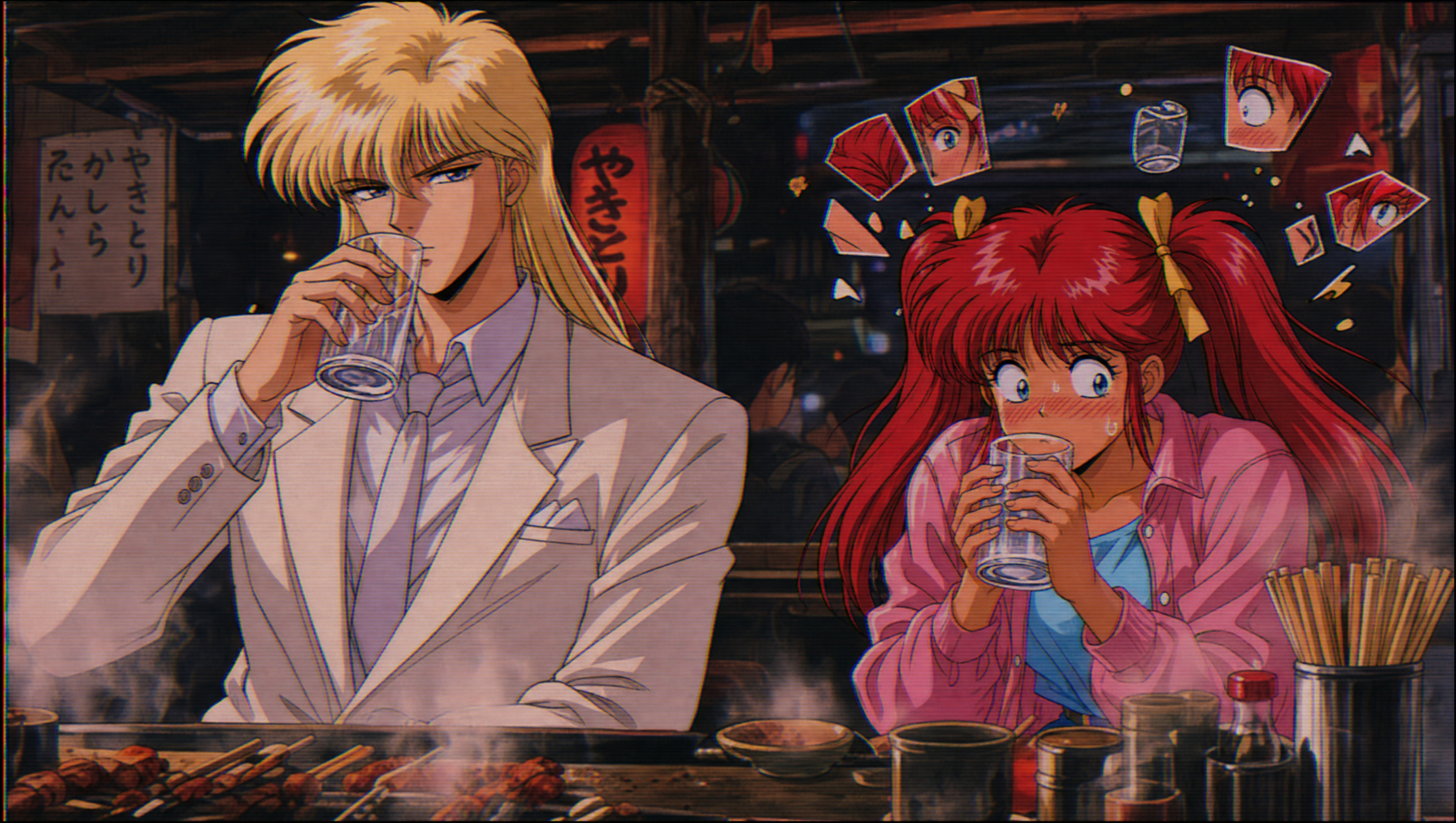
Inside my head, I began collapsing in real time.
Oh, come on. This is not me. What is happening? Why am I completely bubbling like a—
He stood.
Just like that.
Calmly, gracefully, as if my nervous system had not just thrown itself down a staircase in front of him.
He set down enough money to cover his tab and then some—far enough beyond some that even I, who was currently busy dying with dignity, noticed the thickness of the bills in his wallet. Beyond rich. Quietly, decisively rich. The kind of money that didn’t need to announce itself because it assumed the room would understand.
And I was still trying to figure out what to say next.
“See you at the next live. Eden” he said, lifting one hand in a small wave as he turned away from the stall.
And because apparently my dignity had already clocked out for the evening, what came out of my mouth was:
“Thanks for eating, coming, I mean—for… okay, see you at the next event ahahhah—”
A complete disaster.
He only smiled—politely, beautifully, fatally—and kept walking, slipping into the summer Kyoto night with the kind of ease that made the whole street look underdesigned around him.
Noooo, I screamed internally, while externally managing to remain seated and only mildly deceased.
I watched him disappear for maybe one second too long, then another, then another, until even the last suggestion of blond hair was gone into the lights and moving shadows of the street.
After spending a full thirty seconds silently reprimanding myself with the intensity of a military tribunal, I turned to the nearest available victim.
Junpei.
“What was that?” I demanded.
Junpei didn’t look up from the counter. “A customer.”
“You know what I mean.”
He gave me the long-suffering side glance of a man who had fed me often enough to know resistance was pointless.
And so, naturally, I tortured him with a million questions.
“Who was he?”
Junpei slid noodles into a bowl with the dead-eyed patience of a man who had survived rent hikes, drunk salarymen, and me.
“A customer.”
“Yes, thank you, detective, I got that part.”
Junpei shrugged.
I narrowed my eyes at him. “How bad was I?”
He set down a plate with the solemnity of someone presenting evidence in court. “You sat down like the stall was on fire. Then you saw him and forgot how language works.”
I covered my face with both hands. “Please stop.”
Junpei gave a small nod, like a teacher satisfied the student had finally accepted the lesson. “On the bright side,” he said, “he seemed to find it charming.”
That stopped me.
I blinked. “You think so?”
Junpei shrugged again, already wiping the counter. “He stayed calm. Didn’t rush away.”
“Your standards are abysmal.”
Then, just as I was working my way toward a third theory about why beautiful strangers with painter names should be lawfully regulated, Sasaki appeared.
He had that look on him that meant logistics had occurred. In one hand he carried an envelope—my pay, folded flat and insultingly light by the shape of it. In the other, a revised schedule I could already tell I was going to dislike on principle.
“Shun has made new arrangements,” he said.
“Of course he has,” I replied.
Sasaki stopped beside the stool and looked at me properly. Then at Junpei. Then back at me.
His eyes narrowed by approximately one civilized millimeter.
I was aware, suddenly and with some alarm, that I probably looked strange. Not just happy. Not just sad. Both. Lit up and wrecked at once, like a girl who had won something small and lost all structural stability in the process.
Junpei, traitor that he was, said nothing.
Sasaki held out the envelope. “Payment.”
I took it automatically.
He kept looking at me.
“What?” I asked.
“You appear,” he said, choosing the words with unusual care, “chemically unbalanced.”
Junpei gave a quiet cough into his hand that was absolutely not a laugh.
I snapped upright at once.
“No, listen,” I said, turning fully toward Sasaki now, all at once back in the world. “I need to perform here again.”
That got his attention.
Junpei’s too.
Sasaki’s gaze sharpened. “You need to?”
“Yes.”
He glanced once at the stall, the street, the live house beyond it, then back to me. “Why?”
I opened my mouth, and for a second discovered there was no elegant way to say any of this.
“Because I had just met someone.”
Not just someone.
The someone.
“A man?” Sasaki asked.
“Yes,” I said. “A man.”
He considered that in silence, the envelope already gone from my hand into my bag, my fate no doubt being rearranged in his mind against his will.
And I, sitting there under the yellow stall light with my food half-finished and my pulse still not entirely recovered, knew with perfect clarity that my evening had just split in two.
There was before him.
And there was after.