Interlude 03 — Chapter 01
Silent Blue
Three months into this Kiseki Records circus, and they were still calling it a prep room when it was obviously a storage closet with stage envy: drink crates stacked to the ceiling, empty bottles in plastic bins, cables underfoot, a dying floor fan clicking in tired protest.
I stood in the middle of it in a short blue dress and full nerves, rolling my shoulders, flexing my fingers, trying to ignore the thump of the crowd bleeding through the wall.
I’d done this nonstop all summer—Kyoto, Osaka, Kobe, then back again—but jitters were stubborn little animals.
They never died.
They just learned the route.
Sasaki stood by the door in his usual neat suit, somehow managing to look composed in a room that smelled of stale beer and panic.
I stepped out of the closet and into the corridor glow, my orange soda still fizzing in one hand and Shun’s optimism ringing in my ears like a minor head injury.
The Wild Sabers were coming offstage in a wall of leather, chains, and hair so inflated it looked structurally unsound. Up close, they were less band and more urban catastrophe—painted eyes, studded wrists, black boots heavy enough to start wars. They looked like someone had shown Japan a picture of KISS and told it to make the result angrier.
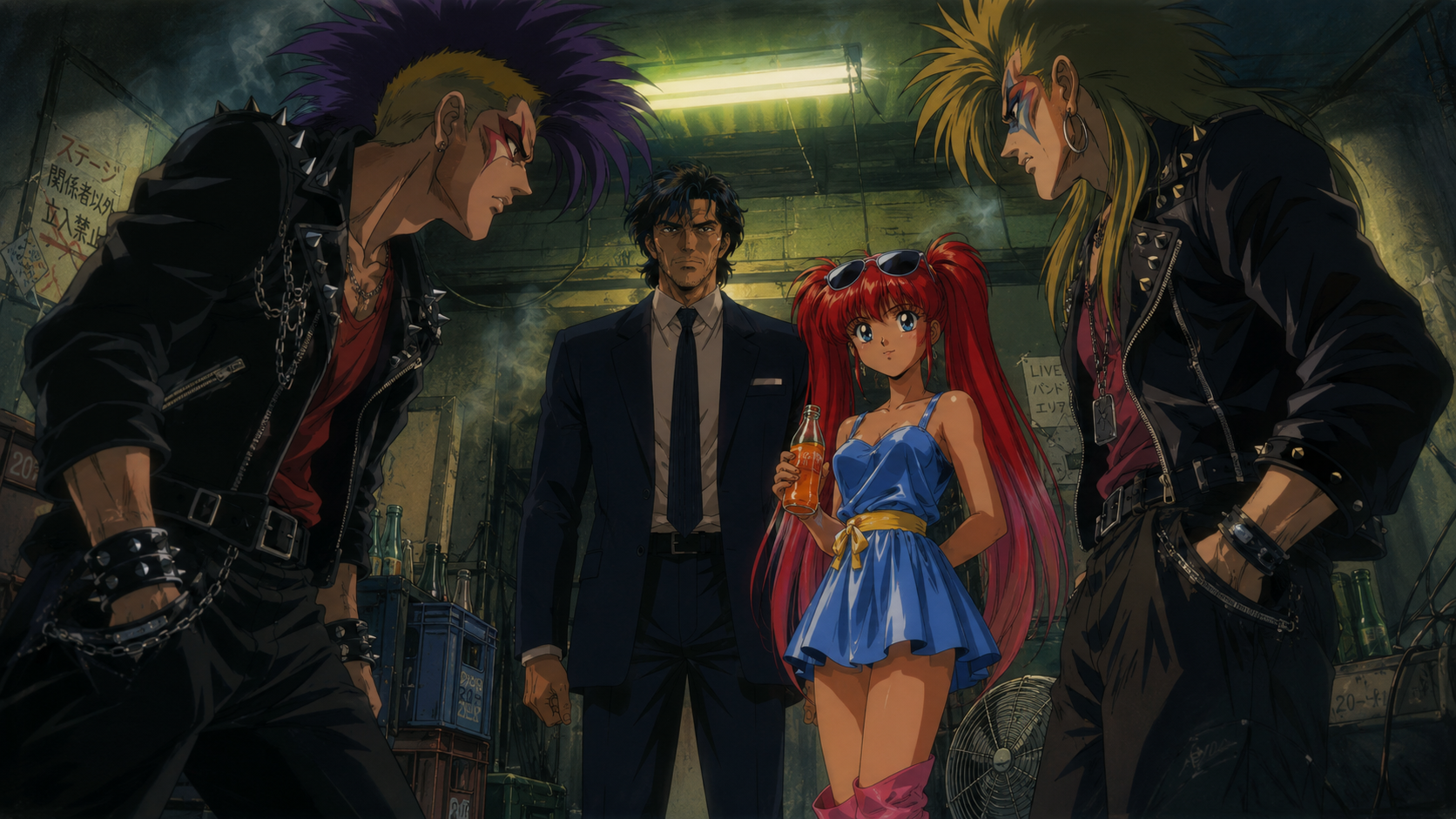
One of them glanced at me as he passed, took in the red hair, the blue dress, the yellow ribbon, the pink boots, and gave me a look usually reserved for bad omens.
Then he stopped.
Of course he stopped.
He turned just enough to drag the others with him and let his eyes travel over me again, slower this time, like he was trying to decide whether I was a joke or a scheduling error.
“What’s this?” he asked, loud enough for the corridor to hear. “You gonna sing a lullaby for the audience?”
I smiled before he even finished.
“Why? You’re sad your mommy’s not here to sing you one?”
That landed clean.
His face twitched. One of the others barked a laugh by accident, then killed it. The first guy took a step toward me instead, pride bruised and looking for somewhere to bleed. Another band member moved in too, not fast, just enough to make the hallway feel smaller.
Then Sasaki stepped forward.
He didn’t shove. He didn’t raise his voice. He didn’t do anything theatrical at all. He simply moved into the space between us with that same exact calm he brought to everything—shoulders squared, posture perfect, every gesture so precise it almost looked artificial until you realized how frighteningly natural it felt.
The two singers recoiled before they’d had time to decide to.
Instinct.
Something in his stillness told them, very clearly, that this was not the kind of man you leaned into twice.
Then Shun came skidding into the moment behind him, all noise and indignation, pointing down the corridor like an angry maître.
“We’re up, you lot! Clear the way!”
One of the Sabers sneered.
“Oh, the rōnin-agent. You bankrupting this label this or next month, Shun?”
Shun jabbed a finger at him at once.
“Shut up, you relic. Mark my words—she’s the future. You’re the past. Punk rock will be done soon.”
They laughed right in his face.
Then they looked once more at Sasaki, standing there without expression, solid as a wall, and decided laughter was enough for one evening.
So they moved on.
Then I walked out into the main room and immediately understood that the Wild Sabers had not, in fact, been wrong.
This was not my crowd.
A few girls sat at the small round tables near the back, watching with the cautious curiosity people reserved for accidents and blind dates. There were some teenagers at the bar too, trying very hard to look older than their bones allowed.
But mostly?
Grizzled faces. Leather jackets. Steel spikes. Cigarette smoke hanging low beneath the lights. Bikers with arms like concrete and expressions suggesting they had come here to be deafened, not charmed.
Shun had failed again.
Spectacularly.
There was no clean route through this one. No obvious way to win them. No version of me that belonged naturally in this room.
Which, unfortunately, changed absolutely nothing.
The stakes were what they always were: make some ripples, sell enough copies to buy food for next month, or starve.
Yay. Show business.
I stopped just before the stage and glanced toward the narrow side window near the bar.
Full moon tonight.
Good.
I didn’t smile, but something in me settled.
I took the two shallow steps up and crossed into the light, adjusted the mic with one small tap, then wrapped my fingers around the stand like I meant it.
Sasaki was already at the side panel, one hand on the lighting controls, posture exact, face unreadable as ever. Shun had thrown himself into the crowd where he was least wanted and most determined to exist, leaning over the bar, waving at people, trying to stir attention with the zeal of a man who believed enthusiasm could overpower market failure.
Maybe tonight it could.
Maybe tonight I could.
Then the first bright, bubbly notes of Lucky Shot skipped out across the room.
And I changed.
Not literally. Not magically. Just completely.
The nerves folded inward. The noise receded. The storage closet, the bad fit, the wrong audience, the rent, the hunger—all of it clicked into place behind glass.
The beat found me, and I let it.
Chin up. Eyes alive. Smile on.
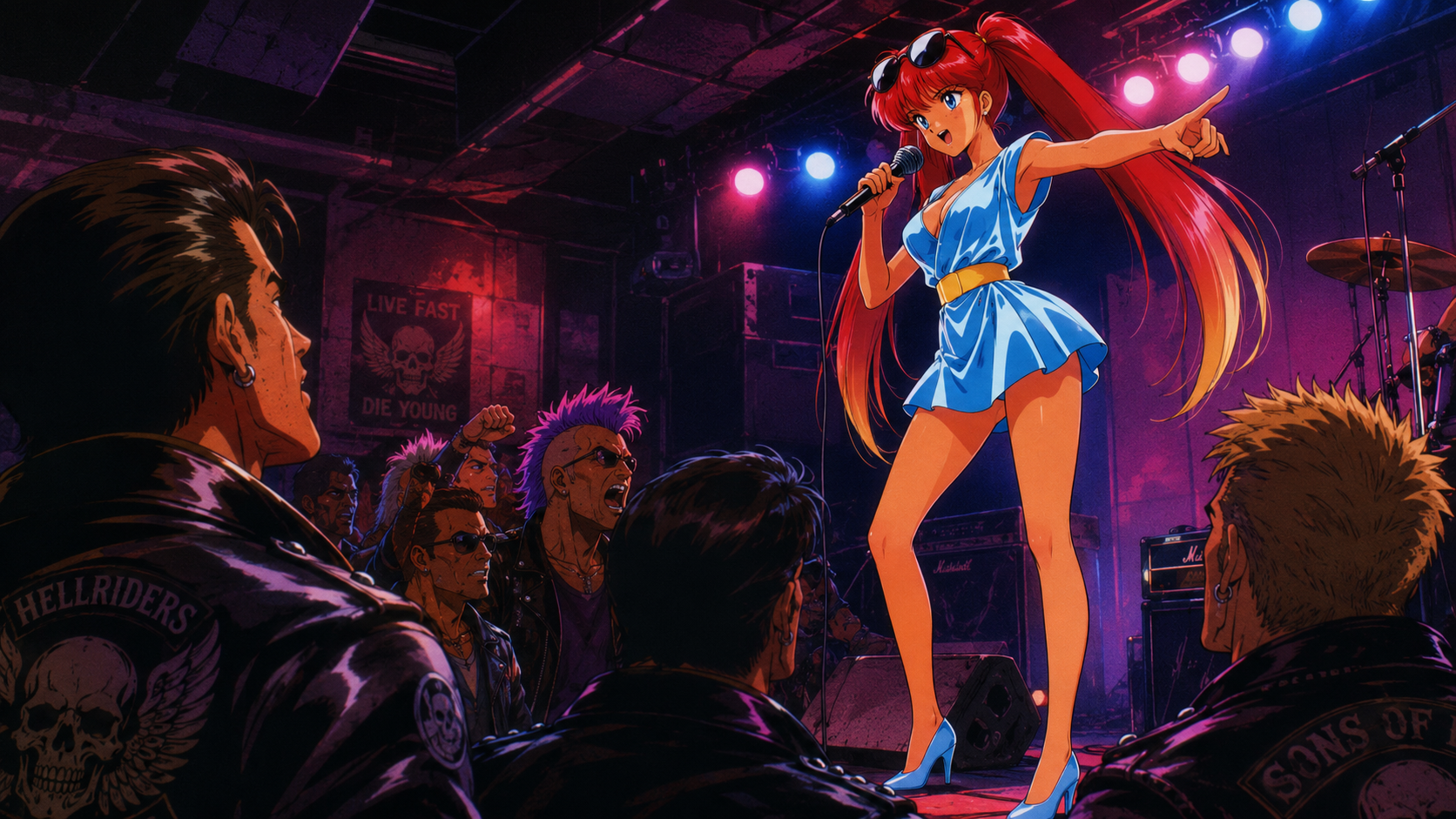
Eden stepped forward where Erika ended.
And just like that, I was no longer a girl in the wrong room.
I was a performance.
And the room would deal with me.
The track came in exactly the way Sasaki hated and Shun adored—commercial, synthetic, bright at the edges, all polished pulse and neon sugar. The kind of song that should have bounced off a room like this and died on impact.
At first, the looks I got were exactly what I expected: sideways grins, folded arms, that half-amused expression men wore when they thought they were being asked to endure something soft.
I didn’t flinch.
I let my gaze move over them one by one, slow enough to be felt. Smoker at the bar. Biker by the pillar. Girl at the back table pretending not to watch. I met each face like I had all night to choose where to land.
Then the vocal came in.
Clean. Precise. Too good to shrug off.
When I opened with “Neon rain, I run tonight,” and let the Japanese follow it like silk slipping after skin, something shifted. Not loudly. Not all at once. Just enough.
A few heads turned fully.
A few conversations died mid-sentence.
A few men stopped performing indifference and simply looked.
Good.
Once they were listening, I knew exactly what to do with them.
I didn’t sing like a beginner asking permission. I sang like someone who had already been judged and had decided to enjoy the room anyway.
One hand slid from the mic stand on the beat. My shoulders turned with the groove. My boots planted in crisp little claims of territory. The choreography was there, yes, but stripped of innocence and sharpened into something else. Not plastic sweetness. Not cute obedience.
Control.
That was the difference.
I could feel my mouth settling into the kind of smile that never gave everything away. My eyes did the rest—soft enough to invite, steady enough to hold, warm enough to feel close, and because of that, more dangerous than anything obvious.
By the pre-chorus, I could feel the room leaning without admitting it.
“Close my eyes, aim my soul—”
I let the line breathe. Let it brush across them instead of pushing.
Then the chorus hit, bright and irresistible.
“Lucky shot, lucky shot—”
And there it was.
Boots tapping before their owners realized.
Heads moving in spite of themselves.
One man near the speaker stack caught himself nodding and looked annoyed, as if his own body had betrayed him.
Too late.
I had them.
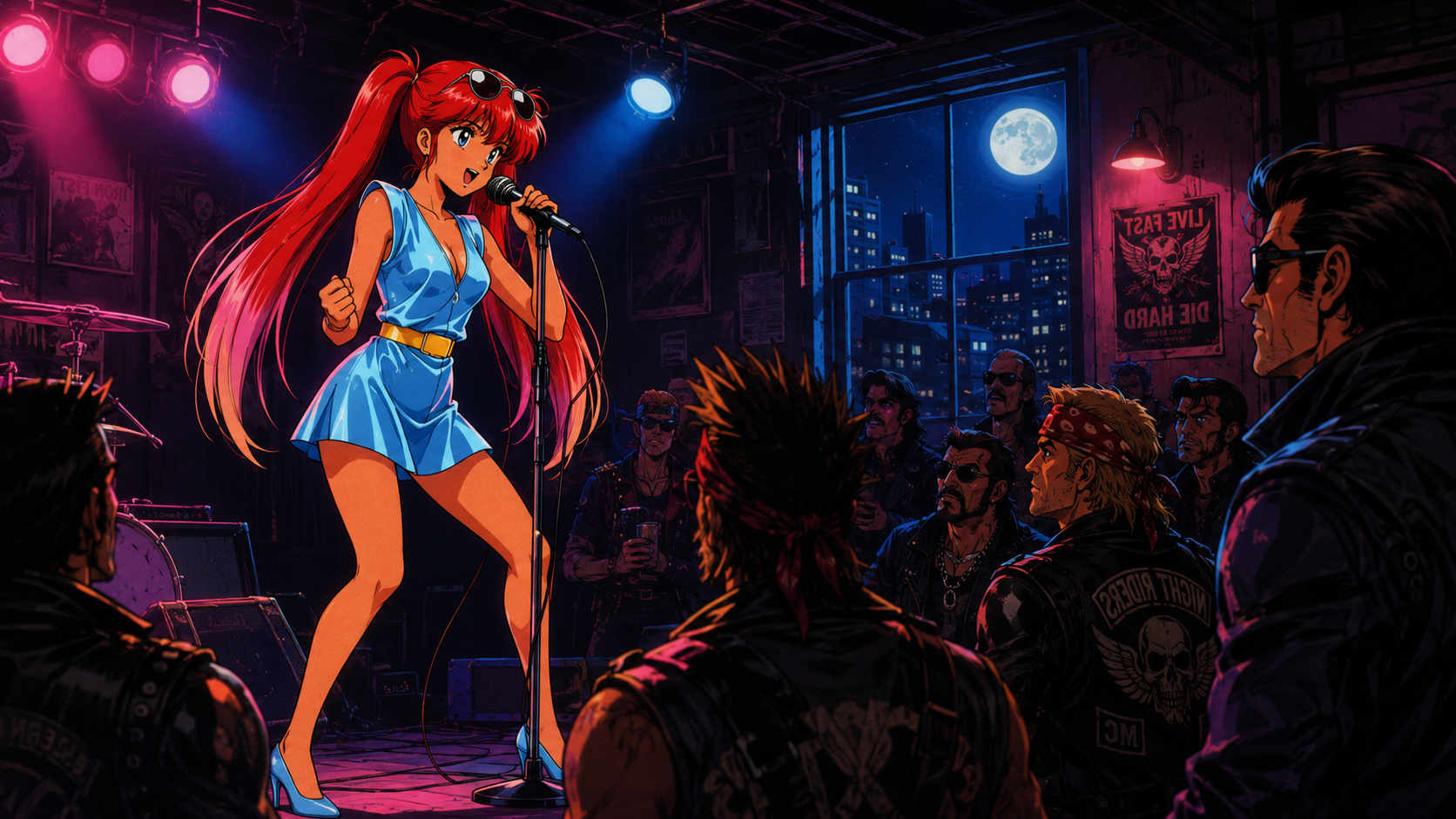
By the second verse, the room was under. Not screaming, not surrendering cleanly—this crowd had too much pride for that—but caught. Held. Following me whether they wanted to or not.
I moved across that tiny stage like it had been built to fit my body. The low synthetic bass rolled under me. The cigarette haze turned soft under the lights. Cheap speakers, sticky floor, stale beer, bad booking—none of it mattered anymore. I made the room take my shape.
Under the moonlight slipping in from the side window and Sasaki’s precise wash of color, I must have looked almost unreal in blue and yellow and pink, all pulse and brightness against a room made of leather, smoke, and old noise.
And that contrast only made it better.
I wasn’t trying to belong to the room anymore.
I was making the room want what didn’t belong there.
Then the bridge came, and I gave it everything—every ounce of nerve, hunger, will, and that stranger, deeper thing inside me that had nothing to do with rehearsal and nothing to do with pop.
“Hush now, hear my vow… Time slows, we know how…”
The song stopped being cute right there.
It became intimate.
I didn’t just survive that room.
I slipped under its skin.
Shun was already halfway to a religious experience by the time the second track came in. I could see him near the bar, both hands up, grinning like he personally had invented applause and intended to patent it.
I stood there breathing through my smile, scanning the faces one by one and making each of them mine for just a second longer.
Sasaki, off to the side, gave the smallest nod. From him, it was practically a standing ovation. Shun looked ready to leave his body entirely and ascend through the ceiling.
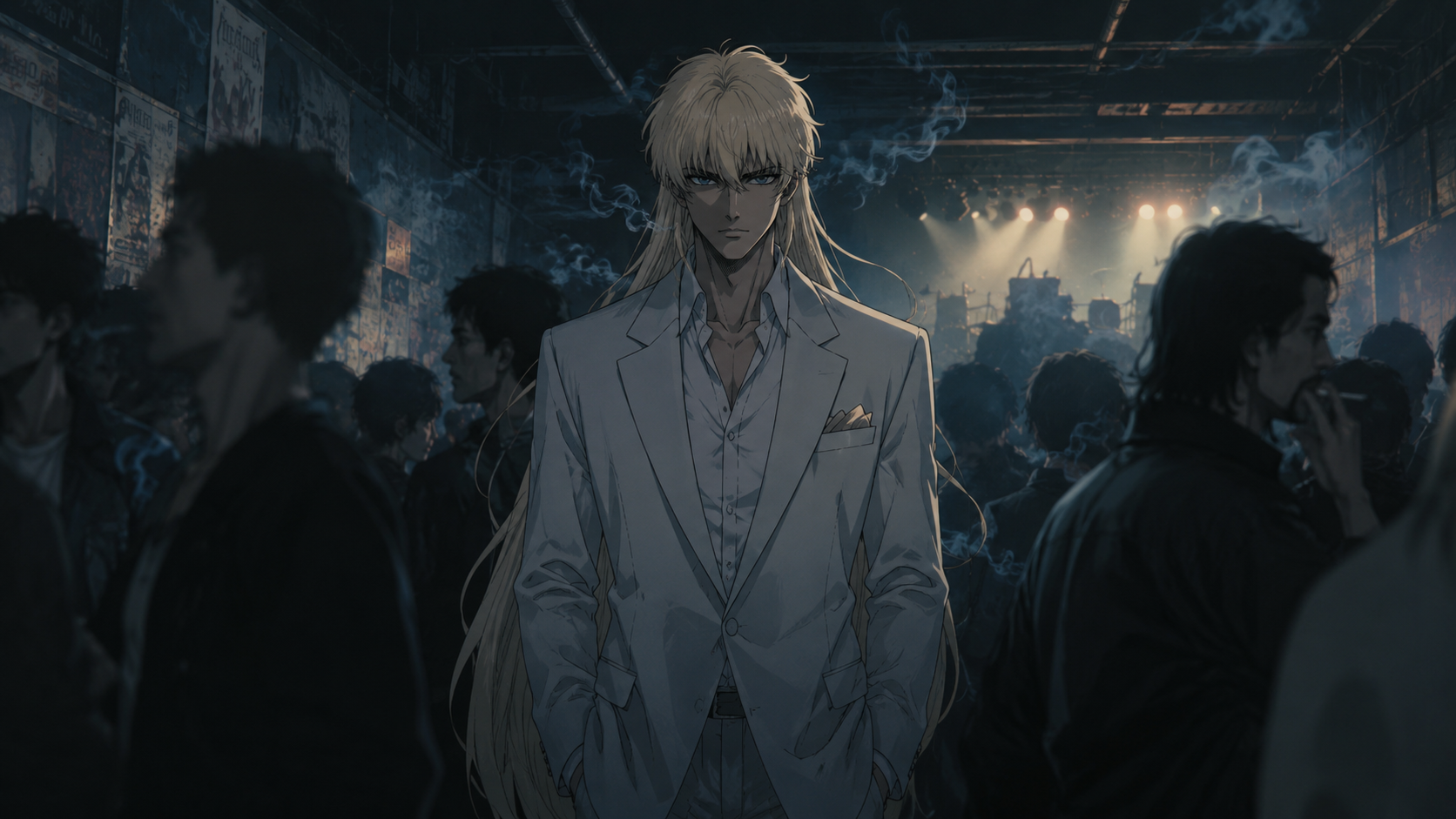
Then my gaze caught on someone in the back of the room.
Tall. Blonde. Standing perfectly still among the smoke and leather and noise. Impossibly long hair. A perfect suit. Unnervingly young.
At first I thought he was simply untouched by me—the only person in the room not pulled in, not softened, not caught somewhere between wonder and ache like all the others.
But it wasn’t that.
The others had listened. Their faces had opened. Their eyes had changed under the song.
His hadn’t.
He was looking at me with a silence so complete it felt invasive. Not resisting. Not admiring. Seeing. His stare moved through the lights, through the dress, through the smile, through Eden herself, as if all of that were only weather laid over something older.
And what made it worse—what made it unforgivable—was that he was beautiful.
Not in the ordinary way. Not in the way of idols or actors or men who knew how to arrange their faces for effect. He looked carved. Balanced too perfectly. The kind of beauty that didn’t invite trust so much as disarm it.
I looked at him, and something closed around my heart at once.